
 1 / 8
14 Nov 2026
13 / Girard-Perregaux
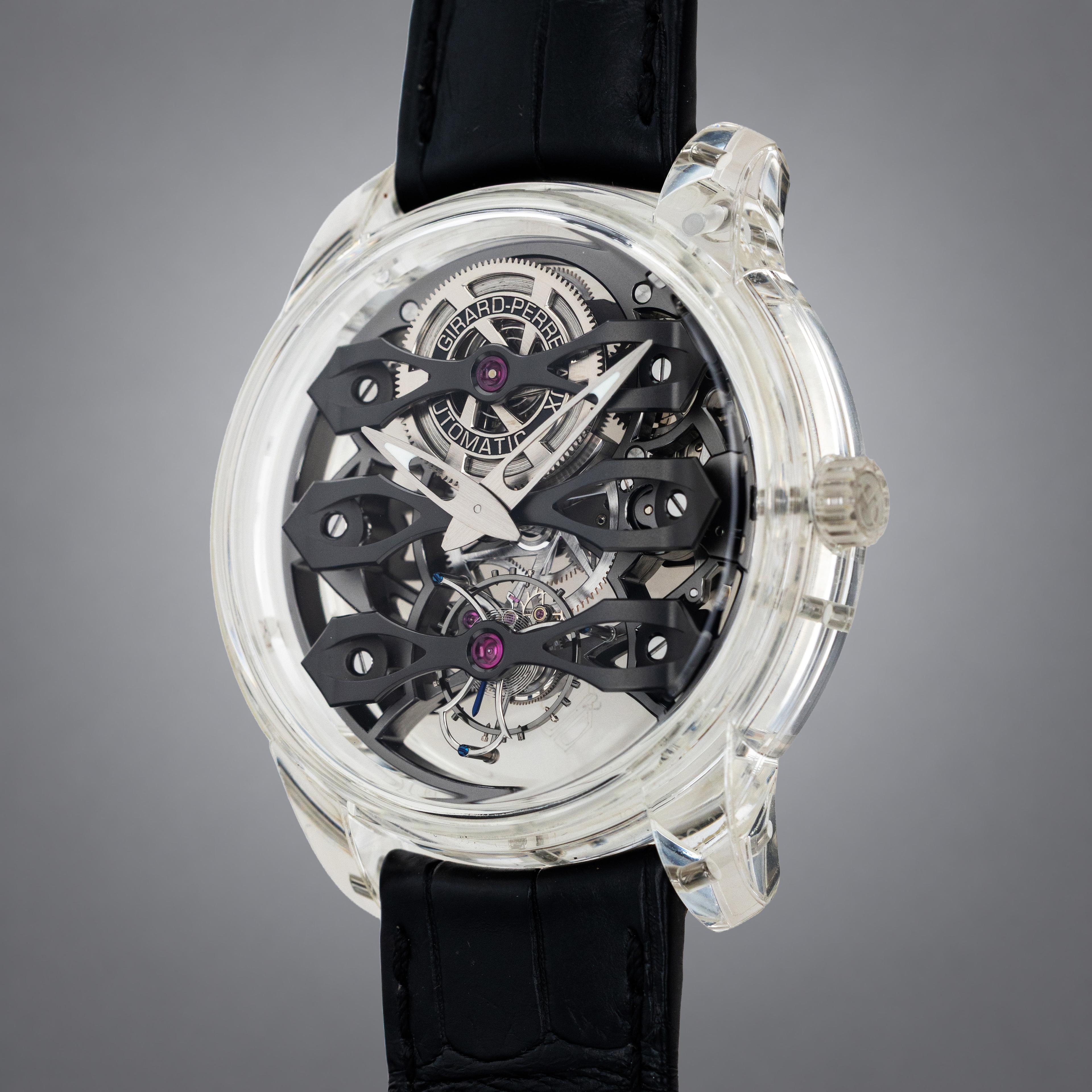
99295, Quasar Tourbillon, Three Bridges, Skeletonised Movement, Sapphire Crystal
Estimate: $80,000 – 120,000
- Brand
- Girard-Perregaux, La Chaux-de-Fonds
- Model
- Quasar Three Bridges Tourbillon
- Year
- Circa 2023
- Reference
- 99295-43-000-BA6A
- Calibre
- GP09400-1035, self-winding, 27 jewels
- Case
- No. 99295, Sa N° 12
- Materials
- Sapphire crystal
- Bracelet
- Black Girard-Perregaux leather strap
- Buckle
- Titanium Girard-Perregaux deployant clasp
- Dimensions
- Ø 46.0 mm (approx.)
- Thickness
- 15.0 mm (approx.)
- Signature
- Dial, case and movement
- Accessories
- Girard-Perregaux warranty card and original box
Girard-Perregaux Quasar: A new dimension of transparency The Girard-Perregaux Quasar represents a striking evolution of the Manufacture's celebrated Three Bridges architecture, combining a tradition dating to the 19th century with an entirely contemporary approach to materials and movement construction. Unveiled in 2019, the Quasar marked Girard-Perregaux's first fully sapphire-cased creation, exposing the intricate mechanics of its skeletonised Neo-Tourbillon movement from every angle. Three sculptural, blackened titanium bridges appear suspended within the transparent case, supporting an elaborate gear train and a one-minute tourbillon at 6 o'clock. At its heart, the self-winding Calibre GP09400-1035 comprises 260 components, offering a minimum 60-hour power reserve. The openworked construction lends remarkable visual depth, allowing light to pass freely through the movement and revealing the sophistication of its mechanical architecture. An exceptional expression of modern haute horlogerie, the Quasar brings together Girard-Perregaux's historic watchmaking identity, advanced material engineering and an uncompromising pursuit of mechanical transparency. --
Biography
Girard-Perregaux, the Spirit of Innovation Girard-Perregaux is a renowned Swiss watch manufacturer, founded in 1856 in La Chaux-de-Fonds (canton of Neuchâtel), Switzerland. Constant Girard (1825-1903), a young watchmaker born in La Chaux-de-Fonds, founded his own company, “Girard & Cie” in 1852. Two years later, he married Marie Perregaux (1831-1912), daughter of a renowned watchmaker from Le Locle (nearby locality located in the Neuchâtel Mountains). Two years after their marriage, in 1856, he renamed the company “Girard-Perregaux”. Since then, the house has remained true to this name. Girard-Perregaux quickly stands out for its expertise. The brand has won numerous awards for its precision chronometers (marine or pocket) and manufactures watches with horological complications (minute-repeater, chronograph, etc.). In 1860, François Perregaux (1834-1877), one of Marie’s brothers, became the pioneer of Swiss watchmaking in Japan. He left for Asia in 1859 and settled in Yokohama where he founded the company “F. Perregaux & Co.” which acted as official agent for Girard-Perregaux. He is the first Swiss watchmaker to establish himself in the Land of the Rising Sun. In 1867, Girard-Perregaux presented a new “sous trois ponts” (under three bridges) calibre, which had become emblematic of the brand. This movement features a unique architecture with three bridges most often covered in polished gold plates, offering a distinctive aesthetic. In 1880, Constant Girard-Perregaux developed a concept for a wristwatch intended for officers of the German navy, the stocks of which were ordered by Wilhelm II (1859-1941), the last German emperor and King of Prussia (1888-1918). To protect it from impacts, the glass is protected by a grid. Two thousand watches were produced, making this model the first large commercial wristwatch ever developed. In 1884, a patent application was filed with the United States Patent Office by Girard-Perregaux to protect the design of its famous movement with three parallel arrow-shaped bridges. In 1889, the tourbillon with three gold bridges, later named “La Esmeralda”, won a Gold medal at the Paris Universal Exhibition. When Constant Girard-Perregaux died in 1903, his son Constant Girard-Gallet (1856-1945) took over the Manufacture. In 1906, as a result of inheritances and company takeovers, the “Bautte” name became the property of Girard-Perregaux. The name refers to a famous Genevan jeweller, watchmaker and entrepreneur who was active in the first third of the 19th century, Jean-François Bautte (1772-1837). In 1930, Otto Graef (1862-1948), a watchmaker of German origin established in La Chaux-de-Fonds since the age of 20 and owner of MIMO brand (Manufacture Internationale de Montres Or), took over the capital of Girard-Perregaux. Over the decades, the brand continues to innovate and develop new technologies. In 1966, the brand launched its first high-frequency movement (36 000 vibrations / hour), the “Gyromatic HF”, which offers increased precision of the watch, and which is rewarded with the price of the Observatory of Neuchâtel. In 1975, to celebrate its technological discoveries, the brand created a sporty model equipped with a polished octagonal bezel and an integrated satin-brushed bracelet, bearing the name “Laureato”, which met with great success. In 1991, Girard-Perregaux achieved a feat by presenting a miniaturized version of the “Tourbillon with Three Gold Bridges” to the size of a wristwatch. A year later, the entrepreneur, architect and former Italian racing driver Luigi Macaluso took over the reins of the company. Under his leadership, the brand signs a partnership with Ferrari, which will give birth to a collection of sports models with complications. In 1994, a new family of ultra-thin calibres was created. These are the “GP 3000” and “GP 3100”. In 2011, Sowind Group, parent company of Girard-Perregaux, became a subsidiary of Kering group, one of the leading companies in the sports and lifestyle world. Kering takes majority stake in Girard-Perregaux. The brand is also a pioneer in the use of avant-garde materials, such as titanium, ceramic and carbon. In 2013, Girard-Perregaux unveiled a constant-force escapement called “Echappement Constant”. This revolution lies in the use of avant-garde materials and cutting-edge technology, in particular the application of a 14-micron silicon flamed blade, a strategic element six times thinner than a hair. Its name refers to one of the emblematic figures of the House: Constant Girard-Perregaux. This feat was honoured at the Grand Prix de l’Horlogerie de Genève (GPHG) the same year and received the “Aiguille d’Or” prize. Today, Girard-Perregaux is recognized as one of the most prestigious fine watchmaking brands in the world. It continues to produce watches of exceptional quality, combining tradition, innovation and design. The brand’s collection includes a wide variety of models, from classic watches to contemporary creations, including unique pieces and limited editions. -- Key dates • 1854: Constant Girard, a watchmaker and entrepreneur, marries Marie Perregaux, thus creating the union between the Girard and Perregaux families. • 1856: “Girard-Perregaux” brand is created. • 1867: Girard-Perregaux wins a Gold medal for its “tourbillon sous trois ponts” (tourbillon under three bridges) at the Paris Universal Exhibition. • 1889: Girard-Perregaux receives a Gold medal at the Paris Universal Exhibition where it presents the “Esmeralda”. • 1971: Girard-Perregaux presents the “Elletronique” watch, one of the first quartz watches on the market. The brand continues to explore technological advances while preserving its traditional know-how. • 1975: launch of the “Laureato” model. This laudatory nickname is a nod to the model’s extraordinary precision results. • 1991: launch of the “Tourbillon sous Trois Ponts d’Or” wristwatch, miniaturization of the eponymous pocket watch. • 2008: Girard-Perregaux unveils the first prototype of its constant-force escapement, the “Echappement Constant”. • 2011: the Kering Group acquires 51% of Girard-Perregaux. • 2014: the “Neo Tourbillon under Three Bridges” imposes new rules in terms of watchmaking aesthetics. • 2021: Girard-Perregaux becomes the partner of Aston Martin brand and creates a model combining aesthetics and functionality. -- Iconic models and current collections • “Laureato”: this collection is one of the pillars of the brand. These watches are characterized by their octagonal case and integrated bracelet. The models are offered in different sizes and materials, with various horological complications, offering a wide variety of styles. • “Vintage 1945”: this collection pays homage to watches from the Art Deco era with its rectangular case and clean lines. These watches combine classic elegance and horological complications. • “Sea Hawk”: this collection is dedicated to professional diving watches. These watches with unidirectional rotating bezel are designed to withstand extreme underwater conditions and offer high-resistance to hydrostatic pressure and optimal readability. • “Cat’s Eye”: this collection is intended for women and is distinguished by its oval-shaped watches and its aesthetic. These watches are often adorned with diamonds and exquisite finishes, offering a combination of style and elegance. • “Bridges”: this collection highlights Girard-Perregaux’s watchmaking expertise with its calibre with visible bridges. These watches are recognized for their unique architecture and exceptional finishes. • “1966”: this collection embodies classic and timeless elegance. These watches feature sleek dials, round cases and traditional horological complications. --