
 1 / 7
14 Nov 2026
15 / Blancpain
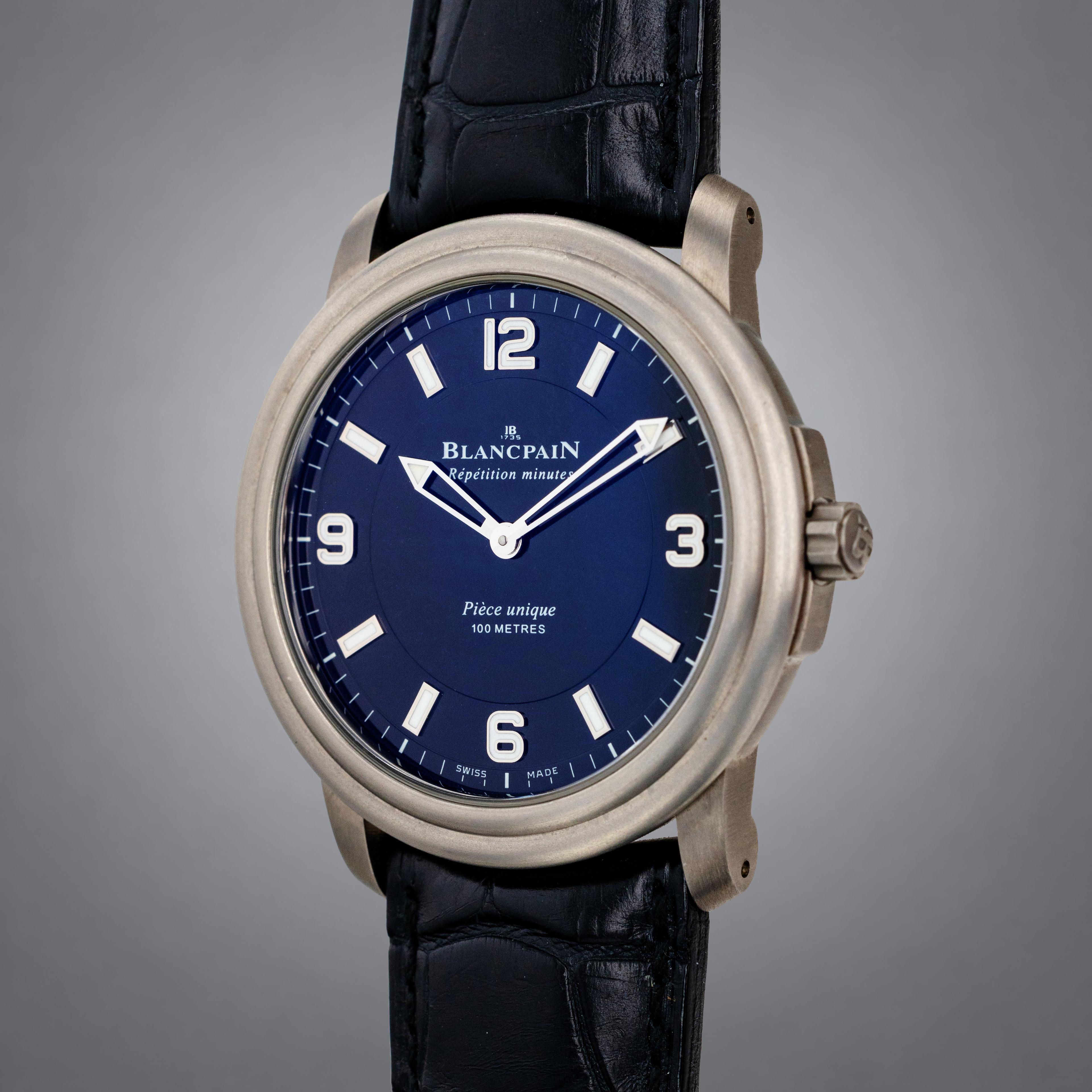
2835-1230; “Piece Unique”, Cathedral-gong Minute Repeater, Aqua Lung, Self-winding, Titanium
Estimate: $20,000 – 30,000
- Brand
- Blancpain, Le Brassus (Vallée de Joux)
- Model
- Léman Répétition Minutes Aqua Lung, “Pièce unique”
- Year
- Circa 2007
- Reference
- 2835-1230
- Calibre
- 351, self-winding, 39 jewels
- Materials
- Titanium
- Bracelet
- Black Blancpain leather strap
- Buckle
- Stainless steel Blancpain folding deployant clasp
- Dimensions
- 40 mm
- Thickness
- 10.4 mm
- Signature
- Dial, case and movement
- Accessories
- Blancpain service documentation
Blancpain Léman Répétition Minutes Aqua Lung: A remarkable feat of acoustic engineering The Blancpain Léman Répétition Minutes Aqua Lung represents an unusual marriage of traditional complications and contemporary engineering. Unveiled at Baselworld in 2007, it addressed a longstanding challenge in minute-repeater watchmaking: achieving meaningful water resistance without compromising the delicate striking mechanism. Blancpain's patented solution employs a sophisticated transmission system, allowing the repeater slide to operate independently of the sealed movement compartment. Within its brushed titanium case, a cathedral-gong mechanism delivers resonant chimes, striking the hours, quarters and minutes on demand. The understated dial, with its luminous Arabic numerals and elegant two-hand display, offers a restrained contrast to the mechanical sophistication within. Turning the watch over reveals a personalised engraving of the Blancpain Manufacture in Le Brassus, accompanied by the inscription “Number One” and a discreet aperture exposing the repeater hammers. Bearing the designation “Pièce unique”, this exceptional timepiece reflects Blancpain's commitment to mechanical ingenuity, acoustic refinement and individual craftsmanship. --
Biography
Blancpain Blancpain is a Swiss watchmaking company founded in 1735 in Villeret in the Vallon de Saint-Imier (Bernese Jura, Canton of Bern) by Jehan-Jacques Blancpain (born 1693). The workshop was continued by his grandson, David-Louis (1765-1816), who was the first to market the family’s products in Europe’s capitals and major cities. Frédéric-Louis Blancpain (1786-1843), son of David-Louis and a former officer in Napoleon’s army, began modernising the family workshop into a series production unit around 1815. This industrial turning point, common at the time, saw the abandonment of the verge escapement in favour of the cylinder escapement. In 1830, Frédéric-Louis associated his son, Frédéric-Emile Blancpain (1811-1857), with the management of the company, which was then named “Fabrique d’horlogerie Emile Blancpain”. At the time, the company was the most prosperous in Villeret. The next generation saw Frédéric-Emile’s three sons – Jules-Emile (1832-1928), Nestor (1833-1906) and Paul-Alcide (1839-1899) – temporarily associated in the “Manufacture de montres E. Blancpain & Fils”. After 1876, only Jules-Emile remained with the company. His youngest son, Frédéric-Emile (1863-1932), was the last member of the family to run the business, while the eldest, Jules (1860-1914), embarked on a brilliant artistic career. Jules-Emile Blancpain builds a two-storey, water-powered factory on the banks of the River Suze. The company becomes “E. Blancpain Fils”. In 1926, Blancpain joined forces with watchmaker John Harwood (1893-1965) to mass-produce one of the first self-winding wristwatches. This collaboration with the British watchmaker also enabled other companies, such as Fortis in Grenchen (Canton Solothurn), to develop and produce similar watches. When Frédéric-Emile Blancpain died in 1932, without issue, the management of the company fell to his close collaborators, Betty Fiechter (1896-1971) and André Léal (?-1939). He represented the seventh generation since Blancpain was founded. Betty Fiechter thus became the first woman President of a leading watchmaking company (June 29, 1933). Born in Villeret and owner of the Rayville S.A. watchmaking company, Betty Fiechter renamed the company “Rayville S.A., successor to Blancpain”, keeping the “Blancpain” trade name to sign her watches. Rayville is the phonetic anagram of Villeret. Despite the difficulties she encountered, in particular the world crisis of the 1930s and the death of her partner, followed by the disruption caused by the Second World War, Betty Fiechter managed to expand production, mainly thanks to the American market, taking advantage of the “New Deal”. Her main customer was the Gruen Watch Co., a major manufacturer that bought movements for ladies’ watches. In 1950, she was joined at the head of Blancpain by her nephew Jean-Jacques Fiechter (1927-2022), who became the new Managing Director, while she herself retained the role of President. Together, they renewed the catalogue of horological calibres, including the world’s smallest round movement, with a diameter of 11.85 mm., designed for jewellery watches, in particular the “Ladybird” model. In the 1950s, they also began producing deep-diving watches, which were increasingly in demand, and launched the “Fifty Fathom” (1953). This watch appeared in 1956 in the film by Commander Jacques-Yves Cousteau (1910-1997), Le monde du silence (The Silent World, Palme d’Or at the Cannes Film Festival). In 1959, the company name was changed to “Manufacture d’horlogerie Rayville S.A. Montres Blancpain”. The company now had 200 employees and an annual production of over 100,000 pieces. Rayville-Blancpain also called on subcontractors who benefited from this boom. Betty Fiechter was still President in 1960 (and remained so until her death) when Rayville-Blancpain became part of the powerful holding company SSIH (Société Suisse pour l’Industrie Horlogère), of which she became a member of the Board of Directors. In 1961, Blancpain became part of the SSIH, where it joined Omega, Tissot and Lémania. In addition to producing watches under its own name, Blancpain became a movement production centre for the group. During the watchmaking crisis of the 1970s, the company remained part of the SSIH. Jean-Jacques Fiechter was President of Blancpain from 1971 to 1980. With things going from bad to worse, the company was put on the back burner and its name finally sold in 1983 for 18,000 Swiss francs to Jean-Claude Biver (born 1949), a Luxembourg-born graduate of HEC Lausanne who has been working in the watchmaking industry since 1975, and Jacques Piguet, Director of the F. Piguet movement factory and descendant of an illustrious line of watchmakers from the Vallée de Joux. The next chapter in the company’s history is now being written in the Canton of Vaud, in the heart of a valley dedicated body and soul to horology. At a time when the return to fine mechanical horology had not even begun, Jean-Claude Biver and Jacques Piguet turned it into a luxury brand, cultivating the spirit of watchmaking tradition and showcasing technical timepieces with horological complications in a uniquely designed case: the “Six Pièces Maîtresses de l’Art Horloger” (Masterpieces of Horological Art), namely: • Ultra-thin • Moon Phase • Perpetual Calendar • Split-seconds Chronograph • Tourbillon • Minute-repeater In 1991, the brand brought out the “1735” model, which combined all the complications of the series in a single watch. All these watches are self-winding. An incredible communicator, Jean-Claude Biver referred to his products as “des vraies montres : celles qui sont fabriquées par les mains des hommes et qui font tic-tac” (real watches: those that are made by human hands and tick) and above all launched an advertising slogan that made history: “Depuis 1735, il n’y a jamais eu de montre Blancpain à quartz. Et il n’y en aura jamais !” (Since 1735, there has never been a Blancpain quartz watch. And there never will be!). In 1992, once they had achieved success, they sold the company to SMH (Société suisse de Microélectronique et d’Horlogerie), chaired by Nicolas G. Hayek (1928-2010), which was later renamed Swatch Group. In 1991, sales totalled 56 million Swiss francs. Jean-Claude Biver remained President of Blancpain until 2002 and held various positions within the Swatch Group until 2004. In 2002, Marc-Alexandre Hayek (born in 1971), grandson of Nicolas G. Hayek, became Chairman of Blancpain. In 2010, to celebrate Blancpain’s 275th anniversary, the brand is releasing a new collection of watches, the “Villeret” collection. Today, Blancpain stands out for its expertise and its commitment to the Swiss horological tradition, while continuing to innovate thanks to complete mastery of the manufacturing process, from design to assembly, while maintaining meticulous attention to detail. This approach is reflected in all its collections, from the classic “Villeret” to the emblematic “Fifty Fathoms” diving watches, as well as the precious “Women” models for ladies and the exceptional “Métiers d’Art” watches. --