
 1 / 7
14 Nov 2026
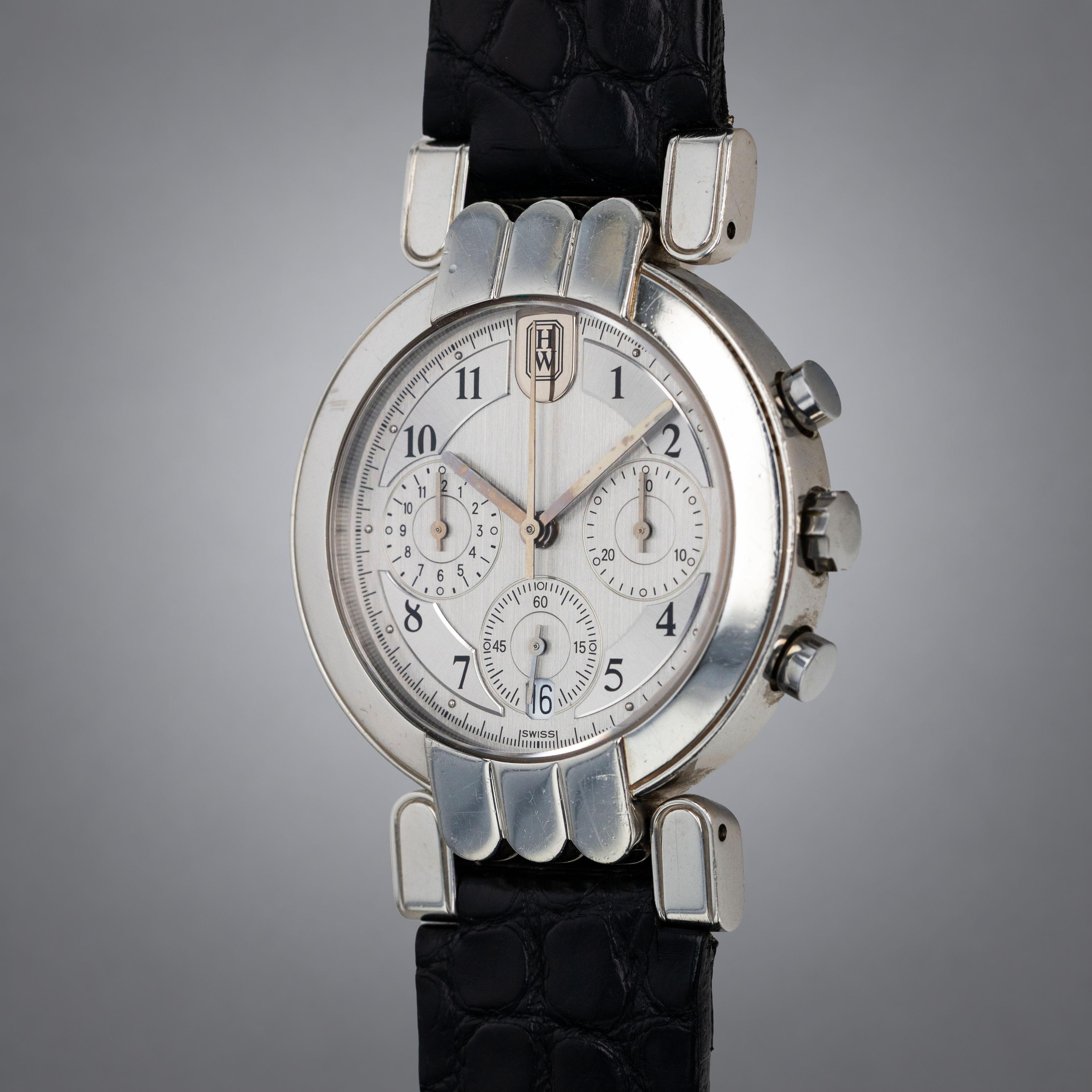
2 / Harry Winston
200/MCA37W, Self-winding, Premier Chronograph; White gold (18-carat)
Estimate: $8,000 – 16,000
- Brand
- Harry Winston
- Model
- Premier Chronograph
- Year
- Circa 2000
- Reference
- 200/MCA37W
- Calibre
- Frédéric Piguet 1185, self-winding, 38 jewels
- Case
- No. 111
- Materials
- White gold (18-carat)
- Bracelet
- Black alligator leather strap
- Buckle
- White-gold (18-carat) HW folding clasp
- Dimensions
- Ø 37 mm (approx.)
- Thickness
- 10.2 mm (approx.)
- Signature
- Dial, case and movement
A Chronograph Inspired by Fifth Avenue Harry Winston's entry into fine watchmaking began in 1989 with the Premier collection, named in tribute to the Premier Diamond Company established by the celebrated New York jeweller in 1920. Bringing the House's distinctive aesthetic into mechanical watchmaking, the collection introduced a recognisable design language inspired by the architecture of its Fifth Avenue salon. The Premier Chronograph exemplifies this approach through its sculptural, articulated triple-arched lugs, recalling the entrance to Harry Winston's New York flagship. Reference 200-MCA37W pairs an 18-carat white-gold case with a satin-finished silvered dial, its three recessed chronograph registers framed by elegantly arranged Arabic numerals. Beneath the transparent case-back lies the self-winding Frédéric Piguet calibre 1185, a sophisticated integrated chronograph movement distinguished by its column-wheel and vertical-clutch construction. The gold-toned oscillating weight, bearing the Harry Winston signature, completes a timepiece that brings together the House's architectural identity and the traditions of Swiss mechanical watchmaking. --
Biography
Harry Winston, King of Diamonds Harry Winston is a Swiss jewellery and watch manufacturer founded in 1932 by Harry Winston in New York. Its history is studded with the most famous and legendary precious stones, including the “Lesotho”, the “Jonker”, the “Taylor-Burton” as well as the famous “Hope” diamond. Harry Winston (1896-1978), whose real name Harry Winston Lewis was born in New York, in the United States in a family involved in the trade of precious stones and jewels. A Ukrainian immigrant, her father, Jacob Winston, sells jewellery and gemstones at a small jewellery store west of town. Young Harry develops an early interest in gemstones. At the age of 12, the boy spots a green stone in a tray of costume jewellery at a pawnshop. While the shop owner thinks it’s a piece of glass, Winston knows it’s an emerald. To avoid attracting the attention of the shop owner, he buys the stone with another for only 25¢. When he presents the stone to his father, he is also convinced that it is only a piece of glass. He is about to break it, but his son stops him just in time. Barely two days after this fortuitous discovery, Winston resold the emerald for 800 dollars. With this success, he began to frequent flea markets and auctions, where he bought and resold stones to make a profit. In 1909, the Winston family moved to the West Coast and reopened their jewellery store in Los Angeles. Winston continued to gain experience working with his father, and after a few years decided to return to New York to begin building his empire. In 1920, at the age of 24, Winston opened his first business: The “Premier Diamond Company”, located at 535 5th Avenue. A newcomer to the industry and self-employed, he can’t count on anyone. He must deploy treasures of ingenuity and work tirelessly to make his business prosper. By 1932, Winston had built an enviable reputation among New York high society. By popular demand, he begins making jewellery under his own name and opens “Harry Winston, Inc.” specializing in high-quality jewellery and gemstones. Harry Winston quickly became known for his passion for diamonds and his ability to spot exceptional stones. In 1935, he acquired the “Jonker”. This 726 carats rough diamond is making headlines around the world. When cut, it yields twelve stones, the largest weighing 125.35 carats. Harry Winston is famous for acquiring and owning some of the world’s most famous diamonds including the “Hope” (1949), the “Winston” (1953), the “Taylor-Burton” (1966), the “Lesotho” (1968), the “Star of Independence” (1976), the “Washington” (1976), which earned him the title of “King of Diamonds” in 1947, a nickname that would follow him throughout his career. The man is a pioneer in the use of diamonds in jewellery, creating innovative and bold designs. He also launched iconic collections, such as the “Cluster” collection (1940) which showcases numerous cluster-set diamonds. Over the years, he prospered and opened boutiques from 1955 in prestigious cities around the world, including Geneva, New York, Paris, and London. The brand becomes synonymous with luxury and fine jewellery. The brand decided to diversify and launched in 1989, in the creation of its first collection of timepieces, thus combining its expertise in “Haute Joaillerie” with the art of “Haute Horlogerie”. It was with the characteristic pioneering spirit of its founder that the first collection of watches, the “Premier Collection”, was born, the name of which echoes the name of the first company opened by Mr. Winston. Other collections that have since become emblematic will follow: the “Ocean” (1998), “Emerald” (2016), “Avenue” (2017) and even “Midnight” collection. In 2001, Harry Winston presented “Opus”, a revolutionary series of innovative limited-edition watches created in partnership with renowned watchmakers. The “Opus 1” model, a “Chronomètre à résonance” designed by François-Paul Journe, made headlines for its technology and an unprecedented sense of innovation in the field of fine horology. In 2007, Harry Winston opened its watchmaking factory in Geneva, housing all the production processes, case manufacturing, watch assembly and setting. Harry Winston watches are characterized by their distinct aesthetics, high quality craftsmanship and use of precious stones. Each watch is crafted with meticulous attention to detail and precision, reflecting the brand’s exceptional craftsmanship. Today, the Harry Winston brand is recognized as one of the most prestigious jewellery houses in the world, renowned for its spectacular creations and its exceptional diamonds and for its watchmaking creations. -- Key Dates • 1932: foundation of “Harry Winston Inc.” in New York, a boutique specializing in high-quality jewellery and gemstones. • 1935: acquisition of the “Jonker” diamond, a large yellow diamond. The “Jonker” diamond has also become one of the most famous pieces in the Harry Winston collection. • 1940: presentation of the “Cluster” collection, characterized by clustered diamond settings. This collection will become emblematic of the Harry Winston brand. • 1943: Harry Winston acquires the “Stotesbury” emerald, a remarkable 34.40 carats hexagonal Colombian emerald. • 1949: acquisition of the “Hope” diamond. This world-famous blue diamond has become one of the most iconic pieces in the Harry Winston collection. • 1955: the first Harry Winston store opens outside the United States, in Geneva, Switzerland. A boutique in Paris, France opened in 1957. This marked the start of the brand’s international expansion. • 1978: Harry Winston dies, leaving behind an important legacy in the luxury jewellery industry. • 1989: the brand launches his first watch collection. • 2001: presentation of the first “Opus”. • 2013: acquisition of Harry Winston Inc. by Swatch Group, thus becoming a subsidiary of the company. -- Iconic models and current collections • “Premier”: the first watch collection launched by Harry Winston in 1989; now an icon of the House. Dedicated exclusively to the fairer sex, the collection captivates by the creativity expressed through its creations highlighting the use of precious stones and high-end materials. • “Midnight”: inspired by the elegance and sophistication of the night, these watches feature sleek dials and elegant cases, emphasizing horological complications such as moon phases, chronographs, and minute-repeaters. • “Avenue”: named after the prestigious Fifth Avenue in New York, this collection evokes the refined aesthetics of the Art Deco period, while integrating graphic elements inspired by the emblematic New York Salon of the house. It offers rectangular-shaped watches with a unique and contemporary design. • “Opus”: this collection is a series of watches that push back the limits of horological creativity. Each “Opus” watch is the result of a collaboration with a renowned watchmaker, resulting in unique and innovative watches. • “Histoire de Tourbillon”: this collection highlights the horological expertise of Harry Winston with watches equipped with tourbillons. • “Ocean”: referred to as the house’s sporty collection, these watches offers a variety of masculine and feminine models combining glamor and functionality. --