
 1 / 8
14 Nov 2026
35 / Piaget
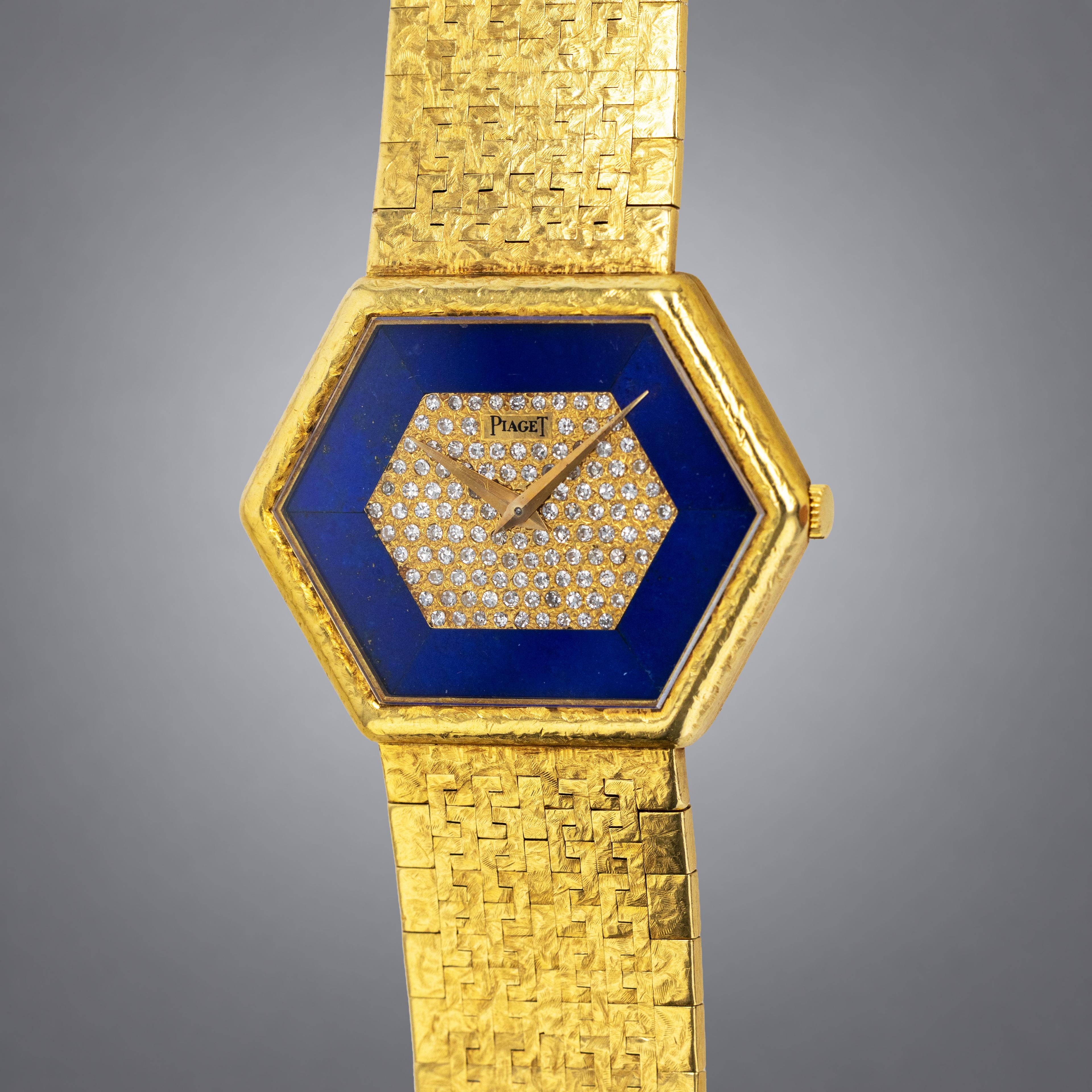
9578 A36, Lapis Lazuli and Pavé-Set Diamonds Dial; Manual Winding, Yellow Gold (18-Carat)
Estimate: $10,000 – 20,000
- Brand
- Piaget
- Year
- Circa 1970
- Reference
- 9578 A36
- Movement
- No. 806 093
- Calibre
- 9P2, manual winding, 18 jewels
- Case
- No. 322 075
- Materials
- Yellow gold (18-carat), lapis lazuli, diamonds
- Bracelet
- Integrated yellow gold (18-carat) Piaget textured brick-link bracelet
- Buckle
- Yellow gold (18-carat) Piaget textured folding clasp
- Dimensions
- 33 x 27.7 mm
- Thickness
- 4.8 mm
- Length
- 207 mm (approx.)
- Weight
- 100.4 gr (approx.)
- Signature
- Dial, case and movement
- Ref. 9578 A36, Lapis Lazuli and Pavé-Set Diamonds Dial; Manual Winding,
- hexagonal-shaped Case, Full Length Bracelet; Yellow Gold (18-Carat)
Geometry in Gold and Lapis Lazuli Piaget's jewellery watches of the 1970s represent one of the Maison's most inventive periods, when its mastery of ultra-thin movements offered remarkable freedom in the design of cases, dials and bracelets. Following the launch of the 21st Century collection in 1969, Piaget embraced sculptural goldwork, ornamental stones and unconventional geometric forms, creating timepieces that blurred the distinction between watchmaking and jewellery. This hexagonal wristwatch captures that distinctive aesthetic. Its vivid lapis lazuli dial surrounds a smaller, pavé-set diamond hexagon, creating a striking contrast of colour and brilliance. The slender gold hands preserve the simplicity of the time display, while the richly textured case extends into an articulated yellow-gold bracelet, lending the composition a continuous, jewellery-like character. The interplay of polished stone, diamonds and intricately worked gold reflects Piaget's enduring fascination with texture and unconventional design. A particularly expressive example of the Maison's 1970s jewellery-watch tradition, it combines geometric precision with the refinement of precious materials. --
Biography
Piaget, the Jeweller-Watchmaker Piaget is a world-renowned Swiss watch manufacturer specializing in luxury watches and jewellery. Founded in 1874 by Georges-Edouard Piaget (1855-1931) in La Côte-aux-Fées, Switzerland, the company began as a small workshop on the family farm. Passionate about horology since a young age, Georges-Edouard devotes himself to the creation of high-precision movements and components. From the beginning, he specialized in the manufacture of exhausts to which he made improvements and distinguished himself by his commitment to technical excellence and innovation, which would be his motto throughout his life. Family roots are important to him. Emma Bünzli (1857-1948), whom he took as his wife in 1881, gave him fourteen children. Like her husband, she is a native of Ponts-de-Martel and a watchmaker by profession. Georges-Edouard will be able to count on this important descendant to develop his project and his future which he only envisages through watchmaking. His first two children, Edouard (1882-1966) and John (1883-1964), perpetuated the know-how of the escapement while their brothers developed new skills. In 1911, his third son Timothée Piaget (1885-1975) took over the company which was incorporated as a general partnership under the name “Georges Piaget et Cie”. Georges-Edouard Piaget continued to closely follow what he initiated until his death in 1931. His know-how, his high standards were decisive for his success but also his formidable ability to unite around his motto “Make always better than necessary” which still resonates today. Timothée had the first factory built and transformed the company, which, from 1916, marketed movements of different shapes and thicknesses, the quality of which attracted major watchmaking houses. From the 1920s, Rolex, Breguet, Cartier, Audemars Piguet, Zenith, Vulcain, Longines, etc. figured among the clients of the house, among others. Piaget affirms its status as a brand and offers refined and precious watchmaking. However, it was not until 1943 that the brand was registered, a decisive step. In 1945, Timothée Piaget passed the reins of the company to his two sons, Valentin (1922-2017) and Gérald (1917-1997). The same year, a new factory was inaugurated in La Côte-aux-Fées; it will be able to accommodate up to 150 employees. Large spaces and large bay windows, the proportions of the new building reflect the family ambitions. Under the direction of Gérald (for commercial expansion) and Valentin (for its creative design), Piaget continues its quest for excellence and innovation. In 1957, during its first participation in the Basel Fair, the brand presented an extra-thin mechanical movement, 2 mm. thick, the manual-winding “Calibre 9P”. The latter served as the basis for the development of another movement that would be a milestone in the history of the brand, the self-winding “Calibre 12P”, presented in 1960, with only 2.3 mm. thickness. Over the years, Piaget expanded its product range to include high-quality jewellery, combining watchmaking and jewellery. Under the impetus of Valentin Piaget, the company works with precious stones, hard stones and gold. He launched collections of cuff-watches and necklace-watches sometimes adorned with more than 30 different stones. In the 1960s, three generations of Piaget were at work. Yves (b.1942), son of Gérald, was introduced to business management very early by his father. After studying engineering in Neuchâtel and gemmology in the United States, he had his first experience in sales, at the Geneva boutique, of which he became director in 1966. He played a key role in the brand’s public relations. by establishing partnerships with celebrities like Salvador Dali (1904-1989), Andy Warhol (1928-1987) or Maurice Chevalier (1888-1972). But he is also very attentive to the profound change that is brewing in watchmaking and to the active participation of the House in research carried out on quartz. In 1976, the “Calibre 7P” was created. With its 3.1 mm. thickness and its exceptional precision ensured by 900 transistors, it offers Piaget the assurance of being spared from the crisis that Swiss watchmaking experienced between 1975 and 1985. At the same time, the brand diversified its activities and launched into fine jewellery. Inspired by the omnipresent nature of La Côte-aux-Fées, Yves Piaget is passionate about the rose, this fragrant flower which will become a symbol of the brand’s collection. A new factory, Prodor S.A., was inaugurated for the brand’s 100th anniversary in 1974 in Geneva. Over the decades, Piaget continues to innovate and push the boundaries of watchmaking and jewellery by creating iconic collections, such as the “Polo” (1979), which has become a symbol of sporting elegance, the “Altiplano” (1998), referring to this high plateau in Latin America with stark landscapes, or the “Possession” collection, whose strong symbolism of the ring within a ring, was launched in 1990. Piaget still known for its fine jewellery creations (necklace-watches, cuff-watches, jewellery watches, adornments, and precious objects) and uses precious stones and artisanal techniques to create unique and luxurious jewellery. In 1988, the brand was acquired by Richemont Group, giving it the assurance of perpetuating the work to which four generations have contributed and strengthening its position on the world watch and jewellery market. In 2001, in Plan-les-Ouates, on the outskirts of Geneva, a new site was inaugurated which replaced the old Prodor premises. In La Côte-aux-Fées, the 1945 building has undergone major successive expansions while retaining the original character of its architecture. Today, Piaget is recognized worldwide as one of the leaders in the field of luxury watchmaking and fine jewellery. The brand continues to create exceptional watches and jewellery, combining traditional craftsmanship, avant-garde design, and technical innovation. Piaget watches and jewellery are sought after by luxury enthusiasts and collectors around the world for their quality, aesthetics, and exceptional watchmaking heritage. -- Key dates • 1874: Georges-Edouard Piaget founded the Piaget brand in La Côte-aux-Fées, Switzerland. Initially, the company focused on the production of high-end watch movements. • 1943: The Piaget name is registered. • 1945: A factory capable of accommodating 150 employees is opened in La Côte-aux-Fées. • 1957: Piaget presents the ultra-thin “Calibre 9P”, just 2 mm. thick. This revolutionary movement became a symbol of Piaget’s watchmaking expertise and established the brand as a leader in the field of ultra-thin movements. • 1960: Piaget introduces the ultra-thin self-winding “Calibre 12P”, just 2.3 mm. thick. This watch movement set a record for finesse at the time and strengthened Piaget’s reputation in the field of ultra-thin watches. • 1979: Piaget presents the ultra-thin quartz “Calibre 7P”, just 3.1 mm. thick. This technological advance confirms Piaget’s position as a pioneer in the development of ultra-thin movements. Birth of the “Polo” collection, elegant and refined sports watches. • 1988: Piaget joins the Richemont Group, which provides financial support and increased international visibility to the brand. • 1990: Launch of the “Possession” collection. • 1998: Launch of the “Altiplano” collection which refers to this high plateau in Latin America with stark landscapes. • 2001: A new building in Plan-les-Ouates, near Geneva, is inaugurated. • 2024: Piaget va fêter ses 150 ans d’existence. -- Iconic models and current collections • “Altiplano”: this collection embodies elegance and finesse. These watches are distinguished by their ultra-flat design and minimalist dial. This collection is loved for its clean style and understated sophistication. The collection takes its name from an eponymous plateau nestled in the heart of the Andes Mountain range, whose purity of bare, unadorned land directly echoes that of the watches in the collection. • “Polo”: this collection is a mix of sportiness and elegance. These watches are characterized by their round case with lugs integrated into the bracelet, creating a fluid aesthetic, a casual and refined style. • “Possession”: a watchmaking extension of the jewellery line of the same name, this collection is dedicated to women. These watches stand out with their colourful dials and interchangeable straps, offering versatility and customizable style. This collection has become an icon of the brand. • “Limelight Gala”: this collection is known for its luxurious and glamorous watches. These watches feature diamond-adorned dials, bold shapes, and refined finishes. Combining art, design and jewellery, these watches are intended for special occasions. --