
 1 / 7
14 Nov 2026
42 / Longines
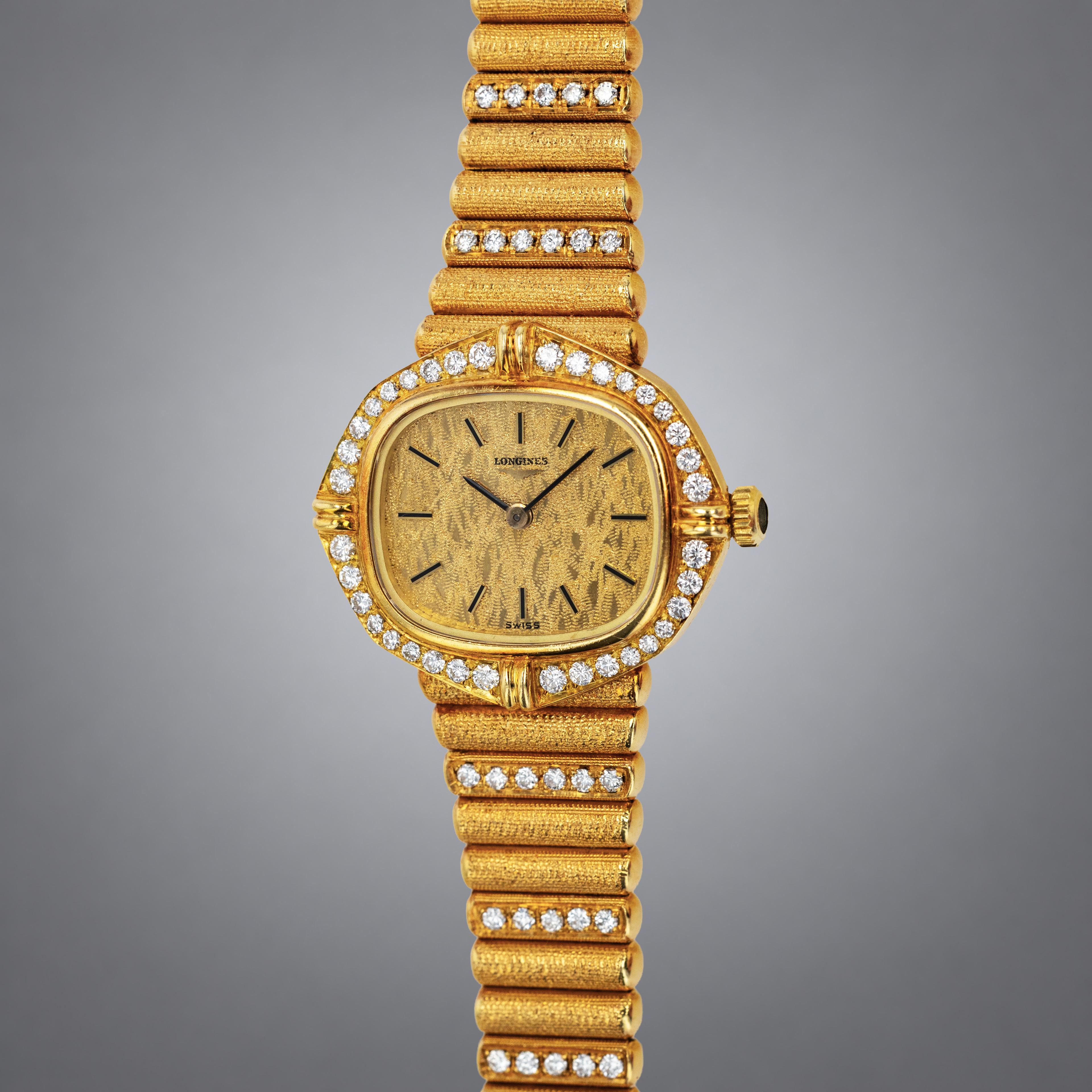
9612, Diamond-set Bezel, Intricately decorated Dial, Case and Bracelet; Yellow gold (18-carat)
Estimate: $8,000 – 14,000
- Brand
- Longines, Saint-Imier
- Year
- Circa 1970s
- Reference
- 9612
- Movement
- No. 53'496'643
- Calibre
- L817.4, manual-winding, 17 jewels
- Case
- No. 18'219'138
- Materials
- Yellow gold (18-carat), diamonds
- Bracelet
- Integrated yellow gold (18-carat) textured bar-link bracelet set with diamonds
- Buckle
- Yellow gold (18-carat) Longines clasp
- Dimensions
- 25.7 x 24.8 mm (approx.)
- Thickness
- 5.8 mm (approx.)
- Length
- 185 mm (approx.)
- Weight
- 75.11 gr (approx.)
- Signature
- Dial, case and movement
Longines Reference 9612: Geometry in Gold The decorative character of the 1970s found expression in watches that blurred the distinction between horology and jewellery. With its sculptural contours, intricate surface finishes and geometric detailing, the present Longines offers an appealing interpretation of this aesthetic, drawing upon the visual language of Art Deco. Crafted in 18-carat yellow gold, its softly squared case is framed by a diamond-set bezel, while the richly patterned gold-tone dial provides a subtle counterpoint to the surrounding brilliance. Particularly distinctive is the articulated bracelet, composed of rounded, finely textured links interspersed with rows of diamonds, creating a rhythmic interplay of light and form. Within the elaborate exterior lies the compact Longines Calibre L817.4, a manually wound movement distinguished by its slim construction and straightforward time-only display. Combining decorative goldwork, sculptural geometry and discreet mechanical refinement, this timepiece reflects an expressive period in Longines' design history, offering collectors an attractive example of vintage jewellery watchmaking. --
Biography
Longines, Pioneering Spirit and Quest for Precision Longines is a Swiss watch manufacturer with a rich history dating back over 190 years. In 1832, Auguste Agassiz (1809-1877) teamed up with other watchmakers to create a “Comptoir d’établissage” in the Swiss village of Saint-Imier (Bernese Jura). At that time, watchmakers manufactured the components at home before assembling them in the workshop. In 1852, his nephew Ernest Francillon (1834-1900), succeeded him in the management of the “Comptoir”. A visionary, he decided to build a factory and developed a mechanised production system to guarantee faster and more efficient production of high-quality watches. For this, he decides to bring together all the craftsmen under the same roof. Francillon has a commercial background and lived in Stuttgart, Germany. He further completed his training with an apprenticeship in watchmaking (1853) in Môtiers (Canton of Neuchâtel), before coming to settle permanently in Saint-Imier (1854). In 1862, Francillon took over the trading post in its own name, under the corporate name “Ancienne Maison Auguste Agassiz, Ernest Francillon successor”. It has a very specific objective: to transform the mode of production. He set up a new reassembly workshop and strengthened the internalisation of certain production activities. In 1866, Francillon decided to abandon the counter model and embark on the industrial manufacture of watches. From 1867, he signed watches with the name “Longines” and no longer with his own name and added a symbol, the winged hour-glass. The abandonment of the patronymic of the manufacturer in favour of a real brand is indeed the sign of a new commercial concept. Francillon develops its first calibres: “20A” in 1867; “18A” in 1868. The implementation of a new work organisation involves changes and an adapted workspace. In March 1866, Francillon acquired land in a place called Les Longines, on the banks of the Suze river. His goal is to use the driving force of a hydraulic installation for the machines he plans to install. The new factory was built and inaugurated in 1867. Right from the start, Longines confirmed its reputation for horological precision and technical innovation. It was a pioneer in the development of watch movements, as demonstrated in 1878 by a pocket chronograph equipped with the “20H” calibre designed to measure time intervals with precision. It was adopted by judges at American racetracks in the 1880s. It was the start of a long commitment to the field of sport. The brand is involved in the measurement of time for international sporting events, such as the Olympic Games and alpine ski competitions. Longines becomes the official timekeeper of many sports and is renowned for its precision and reliability. In 1908, Longines developed a pocket watch indicating two-time zones equipped with double hands for the minutes and the hours. Between 1911 and 1953, the company produced numerous wristwatches with horological complications that bear witness to its technical virtuosity: “retour en vol” (fly-back) function, rotating bezel and water-resistance are at the heart of the brand’s innovations. In the 1930s, Longines extended its expertise in the field of aviation, developing watches for pilots. These watches are prized for their accuracy and readability, and they are worn by famous aviation pioneers such as Charles Lindbergh. In 1954, the “Conquest” collection marked the first stage of a new commercial development strategy: the introduction of product families. The “Flagship” collection will follow in 1957. Over the decades, Longines continued to expand its range of watches, offering elegant models for men and women, as well as diving watches and sports watches:”Legend Diver” (1959), “Ultra-Chron” (1969), “Ultra-Quartz” (1969), “Gold Leaf” (1979), “La Grande Classique” (1992). In 1997, Longines launched the “Dolce Vita” collection. It is inspired by a rectangular-shaped model from the 1920s and pays homage to the Italian way of life. In 2005, the “Longines Master” collection was launched, entirely made up of mechanical movements. In 2020, the “Longines Spirit” collection pays tribute to the pioneers of aviation. Today, Longines is part of the Swatch Group. It continues to perpetuate its watchmaking heritage and remains faithful to its fundamental value of elegance, tradition, and performance. The brand is highly regarded by watch enthusiasts around the world for its exceptional quality and classic style. -- Key Dates • 1832: Auguste Agassiz teams up with other watchmakers to create a “Comptoir d’établissage” in Saint-Imier (Bernese Jura). • 1862: Ernest Francillon takes over the trading post in his name. • 1867: a new factory is built and inaugurated. • 1878: Longines produces its first movement with a chronograph, which allows time to be measured with precision. • 1889: Longines is awarded a Gold medal at the Universal Exhibition in Paris for its innovative and precise watch movements. • 1925: first wristwatch indicating a second time zone. • 1927: Longines becomes the official timekeeper of the Wimbledon tennis championships, marking the beginning of a long history of commitment to the world of sport. • 1954: launch of the “Conquest” collection, a range of sports watches designed for outdoor activities and water sports. • 1979: launch of the ultra-thin self-winding movement (2 mm. thick), marking a breakthrough in watchmaking technology. • 1992: launch of the “La Grande Classique” collection, a symbol of classic elegance and timeless sophistication. • 1997: launch of the “Dolce Vita” collection, inspired by a model from the 1920s. It pays homage to the Italian Dolce Vita. • 2005: the “Master” collection entirely composed of mechanical movement models pays homage to the brand’s horological traditions. • 2020: the “Spirit” collection refers to the pioneering heritage of Longines in the field of aviation. -- Iconic models and current collections • “Conquest”: these watches stand out for their dynamic design, chronograph functions and resistance to hydrostatic pressure. They are designed for sports enthusiasts and adventurers. • “Flagship”: this collection is made up of models equipped with self-winding calibres offering robustness and precision. • “Heritage”: these watches are inspired by the brand’s historic designs and offer a retro aesthetic with modern functionality. • “Master”: this collection is characterised by its classic elegance and refinement. These watches feature sleek dials and horological complications (chronograph, moon phases, power-reserve, etc.). • “HydroConquest”: these watches offer high water-resistance, a unidirectional rotating bezel and optimal readability under water. They combine elegant sporty style and technical performance. • “Dolce Vita”: these watches are characterised by their rectangular-shaped or “tonneau”-shaped cases, their ornate dials and their refined straps. They are designed for women looking for a sophisticated watch. • “Elegant”: these watches are characterised by their understated design, slim cases and sleek dials. They are ideal for formal occasions. --