
 1 / 10
14 Nov 2026
50 / Rolex
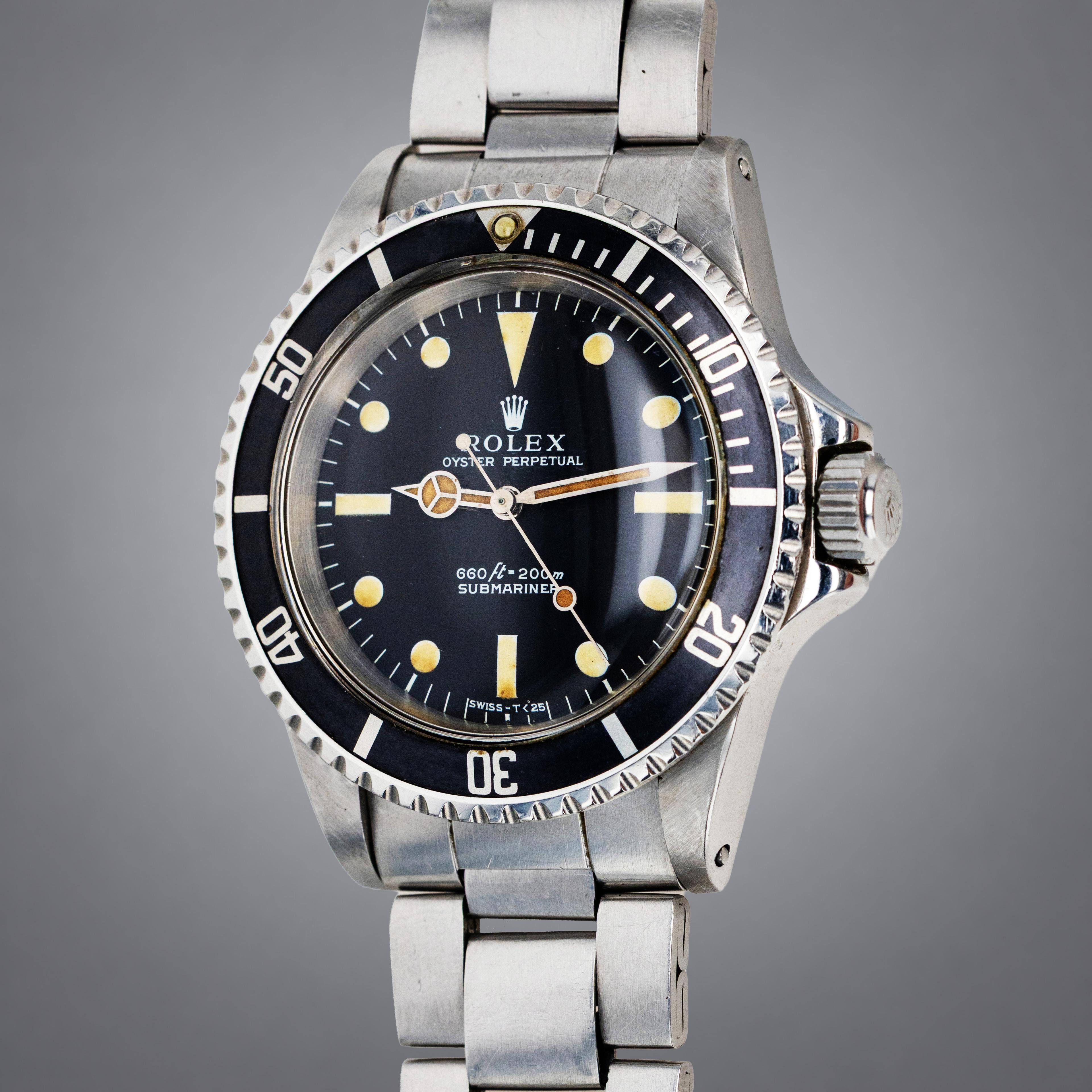
5513, Historical Marine Nationale, "PAT.PEND", French Navy Military Issued, Submariner, Stainless Steel
Estimate: $30,000 – 40,000
- Brand
- Rolex, Geneva
- Model
- Submariner, Nationale Military Issued
- Year
- Circa 1972
- Reference
- 5513
- Calibre
- 1520, Self-Winding, 26 Jewels
- Case
- No. 3068751
- Materials
- Stainless Steel
- Bracelet
- Ref 9315 Patent Pending, Oyster Bracelet, full links, clasp marked "4.69".
- Buckle
- Integrated folding clasp
- Dimensions
- Ø 40.0 mm
- Thickness
- 13.8 mm
- Weight
- 103.1 gr (approx.)
- Signature
- Dial, case and movement
- Accessories
- Green Rolex pouch and Rolex cloth
Rolex Submariner, reference 5513, French Navy This stainless steel Rolex “Submariner”, reference 5513, bears serial number 3,068,751. Manufactured in 1972, it was registered by the French Navy in 1973 under number 020, as indicated by the engraving “020 / M.N.73” on the case-back. It is fitted with the self-winding Rolex calibre 1520. The black dial has luminous triangular, rectangular and circular hour markers, together with “Mercedes” hands. The inscription “SWISS T < 25” at six o’clock indicates the use of tritium in the luminous material. The bidirectional rotating bezel, fitted with a graduated black insert, enables the diver to measure elapsed time underwater. The stainless steel case, approximately 40 mm in diameter, was rated water-resistant to 200 metres (660 feet). The “Oyster” bracelet, reference 9315, comprises thirteen folded links and is fitted with a diver’s extension bearing the inscription “PAT. PEND” (patent pending). The folding clasp is stamped “4.69”, indicating manufacture in the fourth quarter of 1969. –– The Rolex Submariner reference 5513 and the French Navy The history of the French Navy’s diving watches is closely connected with the development of autonomous diving and underwater operations after the Second World War. Established in Toulon in 1945, the Groupe de recherches sous-marines was responsible, among other tasks, for clearing mines from the coast and studying diving techniques. It became the Groupe d’études et de recherches sous-marines (G.E.R.S.) in 1950. From 1955, the Navy went on to establish groups of mine-clearance divers along the country’s maritime coastlines. Meanwhile, Commando Hubert specialised in underwater operations and became a combat-swimmer unit in 1953. In these activities, the watch served as an instrument for measuring time: it helped divers monitor the duration of their immersion and coordinate their operations underwater. The requirements were practical: a watch had to remain legible, withstand shocks and water, and allow the time and elapsed duration to be read quickly. The “Submariner” met these requirements through its water-resistant “Oyster” case, legible dial and rotating bezel. Introduced in 1953, it benefited from the tests and observations of the French diver and engineer Dimitri Rebikoff (1921–1997), who completed 132 dives with one example off the French Riviera. The reference 5513 was introduced in 1962. Without a date display or chronometer certification, it favoured a functional design. It was fitted with calibre 1530 in its early years and subsequently with calibre 1520. Tudor watches occupied an important place in the French Navy’s diving equipment. From 1956, the G.E.R.S. in Toulon evaluated Tudor references 7922 and 7923; other models followed, some later bearing the initials “M.N.” and a year of issue. This provides the broader context for Rolex “Submariner” reference 5513 watches used by the Navy: they attest to the use of Rolex models within its services alongside the Navy’s longstanding relationship with Tudor. The Rolex “Submariner” 5513 watches issued to the French Navy thus combine a civilian diving-watch reference with French military use. The “M.N.” markings and the year engraved on the case-back record this association and place each watch within the period of its registration or issue. Their interest lies in this dual history: that of reference 5513, produced over several decades, and that of operational diving within the French Navy. –– Rolex, reference 5513, Submariner The Rolex “Submariner” reference 5513, introduced in 1962 and produced until 1989, stands as one of the most iconic dive watches of the 20th century. Its exceptional longevity, spanning twenty-seven uninterrupted years, attests to the robustness of its construction and the balance of its design. Unlike the reference 5512, its higher-end counterpart, the 5513 was never awarded chronometer certification, reinforcing its position as a professional tool watch, simple and functional in nature. Its 40 mm. stainless steel case, with solid lugs and a robust middle, is fitted with a bidirectional rotating bezel featuring a black aluminium insert graduated for timing dives. The domed plexiglass crystal, of the Tropic 19 type, contributes to the vintage aesthetic while offering good impact resistance. The 7 mm. screw-down crown, equipped with the “Twinlock” system, ensures water resistance to a stated depth of 200 metres, a high standard for the 1960s. Initially powered by the calibre 1530 (1962–c.1964) and subsequently by the calibre 1520 until the end of production, both automatic three-hand movements were non-COSC certified, explaining the absence of the “Superlative Chronometer Officially Certified” inscription on the dial. The dials of the 5513 evolved in three main phases: from 1962 to 1966, the so-called “gilt-gloss” dials, black lacquered with gold-coloured inscriptions and minute track, featuring fine typography and the distinctive style of the 1960s; from 1966 to around 1982, matte dials with white print and tritium-painted hour markers applied directly to the surface, offering improved legibility; from 1982 to 1989, glossy dials with white gold-surrounded hour markers, heralding the transition to the aesthetic of the modern “Submariner”. The depth rating inscription also varied, early examples showing the “meters first” format, later replaced in the late 1960s by “feet first” on most markets. Between 1972 and 1976, Rolex supplied the British Royal Navy with specially modified versions of the 5513, now known as “MilSubs”. These were characterised by broad luminous “sword” hands, a bezel fully graduated for 60 minutes, fixed solid bars between the lugs, and military engravings to the case-back (“0552”, “W10” depending on allocation). Produced in very small numbers and subjected to intensive use, these watches are now extremely rare and highly sought after by collectors. The 5513 was worn by professional divers, military units and explorers, and also achieved worldwide fame through cinema, with Roger Moore (1927–2017) wearing it in several James Bond films (Live and Let Die, The Man with the Golden Gun), thereby contributing to the model’s legendary status. Today, it is regarded as the archetype of the vintage dive watch: robust, balanced, highly legible and devoid of unnecessary ornamentation. Its longevity, the variety of its variants and its historical role in the evolution of professional watches make it an essential reference for collectors and watch enthusiasts alike. ––
Biography
Rolex, Passion for Perfection Rolex is a world-renowned Swiss watch manufacturer, founded in 1905 by Hans Wilsdorf (1881-1960). The history of Rolex is closely linked to the innovative and visionary spirit of its founder who had a passion for horology and who believed in the possibility of creating precise and reliable wristwatches. In 1905, at the age of 24, he founded the company “Wilsdorf & Davis” with his brother-in-law, Alfred Davis, in London, specializing in the distribution of watches. At the time, wristwatches were still considered unreliable, but Hans Wilsdorf was convinced that they would become precision instruments, both elegant and reliable. To guarantee the reliability of these resolutely innovative pieces in the eyes of the public, he equips them with small, highly precise movements, manufactured by a Swiss factory located in Bienne / Biel (Canton of Bern / Berne). At the same time, he opened a technical office in La Chaux-de-Fonds (Canton of Neuchâtel). In 1908, he registered the “Rolex” brand with the company’s branch located in La Chaux-de-Fonds, which was then transferred to Bienne / Biel. It focuses on the development of high-precision wristwatches. Very quickly, the company experienced success: in 1910, it was a Rolex watch which received the first certificate granted to a wristwatch by the Bureau officiel de contrôle de la marche des montres (Official Office for the Control of Watch Movements) in Bienne / Biel. It has an 11-line movement. Four years later, in 1914, it was the turn of the Kew Observatory, in Great Britain, to issue a Class “A” rate Bulletin to a Rolex wristwatch. In 1919, Hans Wilsdorf transferred the Rolex offices to Geneva, 18, rue du Marché, and founded the company “Montres Rolex S.A.”. In 1926, a major step was taken with the creation of the first waterproof and dustproof watch. Called “Oyster”, this watch with its hermetic case like a safe guarantees optimal protection of the movement. This revolutionary model allows the brand to become a reference in the field of waterproof watches. Thanks to a case equipped with a patented system of screwed bezel, case-back and winding-crown, the hermetically sealed “Oyster” offers optimal protection to the movement. The “Oyster” thus represents a complete horological concept, including the case and the movement with a global perspective of improving chronometric performance. If Hans Wilsdorf presents the “Oyster” as “la plus importante invention de ces dernières années concernant les montres” (the most important invention of recent years concerning watches), it is because its waterproofness also brings a major advance in terms of maintaining precision over time. In 1928, Rolex created the first “Prince” model which was produced until 1935. This model enjoyed immense success thanks in particular to its chronometric prowess. Avant-garde in its rectangular shape, the “Prince” stood out, at the time, for the performance of its movements. It is the subject of a patent for the positioning of the hands in two superimposed dials, one for the hours and minutes, the other for the seconds. Rolex is also a pioneer in the development of the self-winding movement, with its central rotor introduced in 1931. This patented system, called “Perpetual”, allows Rolex watches to wind automatically thanks to the movements of the wearer’s wrist, thus eliminating the need daily manual winding. Since 1927, Rolex has associated its renowned precision and excellence with the world of sport by becoming a sponsor of various leading sporting events. This new adventure begins with the “24 Hours of Daytona”, a 24-hour car race, which today bears the name “Rolex 24 at Daytona”. In 1950, the increasingly prestigious brand was elected the official timing company of the Wimbledon tennis tournament. Rolex will even go so far as to launch watches dedicated to sporting exploits such as mountaineering, aviation or scuba diving such as during the first ascent of Everest or in the depths of the oceans. From now on, Rolex and the world of sport are privileged partners. Rolex owes its fame to its precision watches, but also to its avant-garde spirit from which it has never departed since its creation. Indeed, the epic continues with, in 1945, the release of the “Oyster Perpetual Datejust” model, the first watch to indicate the day of the month. Then, under the direction of André Heiniger, Swiss business leader who succeeded Wilsdorf, other versions of the “Oyster” were created, such as the “Oyster Perpetual Submariner” which withstands depths of one hundred meters or even the “Oyster Perpetual GMT-Master” on which you can read the time in two different time zones. Today, Rolex is considered one of the most prestigious and iconic luxury watch brands in the world. It offers a wide range of models, ranging from diving watches to dress watches, including sports watches, with its emblematic models such as the “Datejust” (1945), the “Day-Date” (1956), the “Submariner” (1953), the “GMT-Master” (1955) and the “Cosmograph Daytona” (1963). Rolex is widely recognized for its quality, precision, and prestige in the watch industry. Each watch is manufactured with great attention to detail, using high-quality materials and benefiting from rigorous quality control. The brand places great importance on the precision and reliability of its watches, and each watch is chronometer certified, attesting to its precision certified by rigorous testing. Rolex embodies the perfect alliance between aesthetics, functionality, and durability. His watches are symbols of status and success and are sought after by collectors and watch enthusiasts around the world. -- Key dates • 1905: Hans Wilsdorf founds “Wilsdorf & Davis” in London, England, which later became Rolex. Initially, the company focused on the distribution of watches, but Wilsdorf aimed to create precision wristwatches. • 1910: Rolex becomes the first watch brand to receive official certification from the Bienne / Biel Bureau officiel de contrôle de la marche des montres (Official Office for the Control of Watch Movements). • 1926: invention of the “Oyster” waterproof case, which is the first waterproof and dustproof watch case for a wristwatch. This revolutionary innovation reinforces Rolex’s reputation for robustness and resistance to the elements. • 1931: invention of the “Perpetual” rotor, the first self-winding system with a central oscillating weight. This system uses the natural movement of the wrist to wind the watch, eliminating the need for manual-winding. • 1945: launch of the “Datejust”, the first self-winding chronometer wristwatch to display the date in an aperture on the dial. This prestigious watch comes with the “Jubilee” bracelet created especially for it and has a fluted bezel: a Rolex watch recognizable at first glance. It is the mainstay of the “Oyster Perpetual” collection. • 1953: launch of the “Submariner” watch, the first diver’s watch waterproof to 100 metres. This watch became iconic in the field of scuba diving and set the standards for later dive watches. • 1956: presentation of the “Day-Date” watch, which displays not only the time, but also the entire day of the week. It quickly became a reference watch for influential people and heads of state. • 1967: introduction of the calibre 1575 with the “GMT-Master” function, which displays a second time zone. -- Iconic models and current collections • “Datejust”: a timeless Rolex classic. It is characterized by its dial with the date displayed at 3 o’clock, its classic-shaped case and its “Jubilee” or “Oyster” bracelet. It is a versatile watch, suitable for formal or casual occasions. • “Day-Date”: also known as “President”, it is a prestigious watch. It is characterized by its dial displaying the day of the week and the date, its precious metal case and its “President” bracelet. • “Explorer”: this model embodies the spirit of adventure and discovery. It is designed to withstand extreme conditions and offers optimal readability. It is a simple, elegant and functional watch. • “Submariner”: legendary diving watch, appreciated for its robustness, reliability and functionality. It features a unidirectional rotating bezel and high-water resistance. • “GMT-Master”: it is a watch designed for travellers. It has a GMT function, allowing two-time zones to be displayed simultaneously. It is also appreciated for its distinctive aesthetic, with a two-tone bidirectional rotating bezel. • “Daytona”: this is Rolex’s emblematic chronograph watch. It is often associated with the world of motor sports and is appreciated for its sporty design and its readable dial. --