
 1 / 7
14 Nov 2026
53 / Audemars Piguet
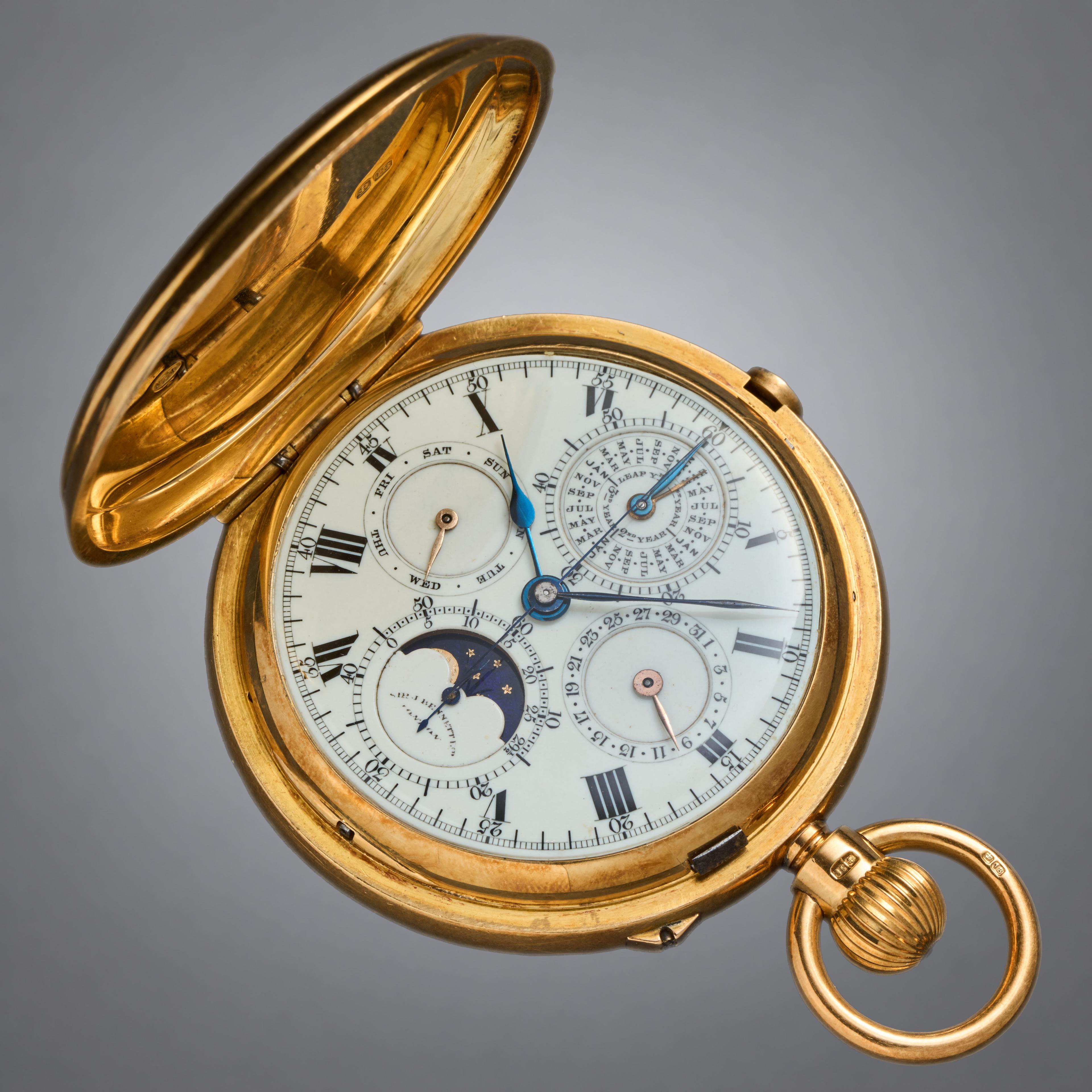
Rare, Double Complication, Hunting-Case, Monopusher Chronograph, Perpetual Calendar, Made for Sir John Bennett Ltd., Yellow Gold (18-carat)
Estimate: $30,000 – 60,000
- Brand
- Audemars Piguet, Le Brassus (Vallée de Joux)
- Model
- Double Complication Hunting-Case Pocket Watch
- Retailed by
- Sir John Bennett Ltd., London
- Year
- Circa 1901–1902
- Movement
- No. 6'680
- Calibre
- 19¾ lignes, manual-winding, probably 20 jewels
- Case
- by Frederick Thoms, Clerkenwell, London
- Materials
- Yellow gold (18-carat)
- Dimensions
- Ø 54.6 mm
- Thickness
- 16.8 mm
- Weight
- 166.7 gr (approx.)
- Signature
- Dial, case and movement
The present John Bennett pocket watch, incorporating Audemars Piguet, is a remarkable example of highly complicated watchmaking from the beginning of the 20th century. Housed in an impressive 53.5 mm yellow-gold (18-carat) hunter case, the watch combines a perpetual calendar, chronograph and moon-phase indication, representing some of the most prestigious complications available during the period. Its beautifully composed white enamel dial, signed John Bennett, London, displays an impressive wealth of information while maintaining excellent symmetry and visual balance. Bold Roman numerals, finely executed subsidiary indications and blued-steel hands are complemented by the charming moon-phase display at 6 o’clock, creating a particularly elegant expression of Edwardian-era horology. At its heart is the substantial 19¾ lignes, manual-winding, manufactured by Audemars Piguet in Le Brassus. According to archival information published for the watch, the movement was sold to Guignard in London in 1906, illustrating the important connection between the specialist watchmakers of the Vallée de Joux and London's prestigious horological trade. ––
Biography
Audemars Piguet, Watchmaking in its Raw State Audemars Piguet is a world-renowned Swiss watch manufacturer, founded in 1875 by Jules-Louis Audemars (1851-1918) and Edward-Auguste Piguet (1853-1919). Both from watchmaking families, the two founders joined forces and created their own workshop in their native village of Le Brassus, in the Vallée de Joux. They undertook to fashion complicated mechanisms by hand, going against the trend towards mass production driven by the rise of industrialization. From the outset, the two watchmakers were driven by the desire to make their house shine on an international level while being very attached to artisanal production. Audemars Piguet then distinguished itself by manufacturing high-quality watches, using innovative watchmaking techniques and focusing on complicated watch movements. The company quickly gained a reputation for its exceptional know-how and sense of innovation. As early as the 1880s, Audemars Piguet opened a small workshop in Geneva, thus allowing the house to get closer to its customers and to be able to inscribe the word “Geneva” on its dials. The city of Calvin has been considered, since the 17th century, as one of the centres of the world watch trade and having a base in the city was an important commercial asset at that time. This workshop closed in 1970, causing the mention “Geneva” to disappear from the dials. In 1892, Audemars Piguet created its first minute-repeater wristwatch, the overall aesthetic of which was closer to a pendant watch than a real wristwatch. Over the decades, the company continued to innovate by launching wristwatches with complications such as chronographs (286 examples produced between the 1930s and 1950s), perpetual calendars and double or triple calendar watches. The brand stays true to its artisanal heritage by handcrafting each watch to rigorous standards. Audemars Piguet master watchmakers and craftsmen are renowned for their expertise in techniques such as engraving, guillochage and enamelling. The Maison is also appreciated for its distinctive design and refined aesthetic. The “Royal Oak”, reference 5402, launched in 1972 and today nicknamed “Jumbo”, became one of his most emblematic creations. Designed by Gérald Genta, the “Royal Oak” is the first sporty luxury watch in stainless steel. Featuring a revolutionary design with an octagonal case and calibre 2121, the thinnest self-winding mechanical movement in the world, it became over the years a symbol of casual elegance and would influence the watch industry in its entirety. In 1986, Audemars Piguet introduced the world’s first self-winding wristwatch with a tourbillon regulator, which at the time was the thinnest and smallest tourbillon mechanism in the world. Among the models that followed were minute-repeater wristwatches, chronographs, such as the reference 5020, perpetual calendar watches and the “Royal Oak Offshore”, introduced in 1993. The genesis of this model dates back to 1989 when Emmanuel Gueit, a young designer, unveils the sketches of a nonconformist concept: an extremely massive, antimagnetic “Royal Oak”, capable of withstanding the forces of nature and the practice of extreme sports. Presented at the Basel Watch Fair in 1993, the watch clashed and shocked but also opened a new chapter in the history of watchmaking, that of oversized watches. The company is one of the only two major independent watch manufacturers still in family hands. Today, Audemars Piguet continues to produce world-renowned fine watchmaking watches. The brand offers a diverse range of collections, including men’s and women’s watches, complication watches and jewellery watches. Each watch is the result of meticulous craftsmanship and embodies the perfect alliance between tradition, innovation and aesthetics. -- Key dates • 1875: Jules-Louis Audemars and Edward-Auguste Piguet founded Audemars Piguet in Le Brassus, in the Vallée de Joux, in Switzerland. Together, they begin to produce high-end watches with horological complications. • 1882: first minute-repeater movement. • 1892: first minute-repeater wristwatch. • 1972: launch of the “Royal Oak”, a sports watch, in stainless steel, designed by Gérald Genta. Its bold design and octagonal case became iconic and revolutionized the watch industry. • 1993: launch of the “Royal Oak Offshore”, an even sportier and more robust version of the “Royal Oak”, which quickly becomes a symbol of luxury and performance. • 1997: launch of the “Royal Oak Offshore Chronograph”, an extreme sports watch with an oversized case and innovative materials. • 2006: 30th anniversary of the “Royal Oak Offshore”; limited edition launch of the “Royal Oak Offshore 30th Anniversary” with a reinterpreted design. • 2019: launch of the “Code 11.59” collection by Audemars Piguet. -- Iconic models and current collections • “Royal Oak”: one of Audemars Piguet’s most emblematic models. Designed by legendary designer Gérald Genta in 1972, it is considered the first sporty luxury watch in stainless steel. Its octagonal case and integrated bracelet have become symbols of the brand. • “Royal Oak Offshore”: launched in 1993, this is a larger and bolder version of the original “Royal Oak”. It is designed for extreme sports enthusiasts and offers sportier designs, additional complications and innovative materials. • “Royal Oak Concept”: this collection embodies the spirit of innovation and audacity of Audemars Piguet. These watches are distinguished by their futuristic designs, innovative materials and avant-garde complications. They are often used to present the brand’s latest technological advances. • “Millenary”: this collection offers oval-shaped watches with off-centre dials and horological complications. It is distinguished by its original design and its emphasis on artisanal watchmaking. • “Jules Audemars”: this collection pays tribute to one of the founders of the Manufacture. These watches embody classic elegance and highlight traditional horological complications, such as perpetual calendars and minute-repeaters. --