
 1 / 10
14 Nov 2026
64 / Patek Philippe
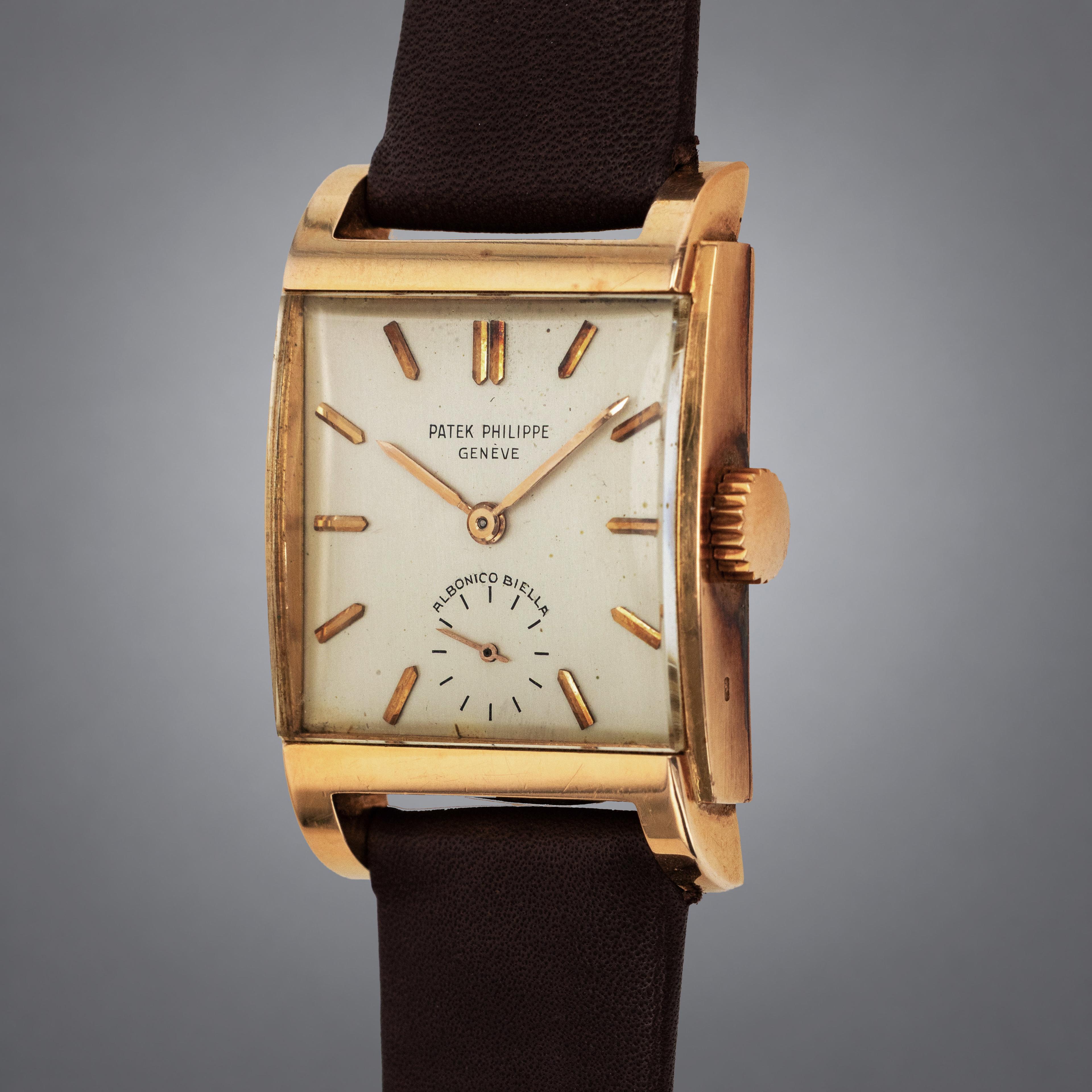
2476R, A Unique "Albonico, Biella", Curved lugs, Pink gold (18-carat)
Estimate: $20,000 – 40,000
- Brand
- Patek Philippe, Geneva
- Retailed by
- Albonico, Biella, Piedmont (Italy)
- Year
- Circa 1951
- Reference
- 2476 R HL (Heures Lapidées or lapidated hours)
- Movement
- No. 973 771
- Calibre
- 9-90, manual-winding, 18 jewels
- Case
- No. 512 540 (by Georges Croisier, Geneva)
- Materials
- Pink gold (18-carat)
- Bracelet
- Leather strap
- Buckle
- Pink gold (18-carat) pin-buckle
- Dimensions
- 26 x 39 mm (approx.)
- Thickness
- 9.3 mm (approx.)
- Signature
- Dial, case and movement
- Accessories
- Extract from the Archives
The wristwatch presented here is in excellent condition. Bibliography • Nael, Ali, Patek Philippe, My Dream Collection, 2021, pp. 134-135. –– Patek Philippe, Reference 2476 Reference 2476 is launched in 1950 and remained in production until circa 1957. This rectangular-shaped wristwatch is fitted with a 9’’’ rectangular-shaped movement, the manual-winding Cal. 9-90. The watch is generally made in yellow gold or in pink gold, more rarely in white gold. The two-piece case, snap-on case-back, was made by Georges Croisier, Geneva (master hallmark number 5; this number inside the Key of Geneva). The ends of the bezel become one with the lugs, the whole slightly curved, overhanging and following the shape of the case. The dial was made by Stern Frères, Geneva. Around 200 to 210 examples were produced. Production can be subdivided as follows: • Yellow gold (Ref. 2476 J), approximately 120 pieces, of which around 20 appeared on the art market • Pink gold (Ref. 2476 R), approximately 80 pieces, of which around 14 appeared on the art market • White gold (Ref. 2476 G), approximately 6 to 12 pieces, of which only one appeared on the art market The watch is today nicknamed ‘Half Hooded’ by collectors. Bibliography • Nael, Ali, Patek Philippe, My Dream Collection, pp. 134-135. –– Albonico, Biella Situated in Piedmont, at the foot of the Alps and close to the Po Valley, Biella has historically been one of Italy’s principal centres of the wool and textile industries. Wool working has been documented there since the Middle Ages, but it was particularly during the nineteenth century that the city and the surrounding valleys underwent considerable industrial development, to the extent that Biella was sometimes referred to as the “Italian Manchester”. The production of high-quality woollen goods and textiles contributed to the prosperity of a substantial industrial and mercantile bourgeoisie. This tradition remains closely associated with the identity of the city, which in 2019 was designated a UNESCO Creative City in recognition of its expertise in the textile field. It was within this prosperous economic environment that the history of the Albonico jewellery business developed. The firm was not founded by the Albonico family, but represented the third generation of a watch and jewellery business established in Biella in 1886 by Ottavio Cucco and continued today by the Boglietti family. In 1886, after gaining professional experience with the Gramaglia jewellery firm in Turin, Ottavio Cucco opened a jewellery shop at 62 Via Umberto in Biella. The establishment gradually became one of the city’s leading watch and jewellery retailers. Patek Philippe occupied a particularly important position among the manufactures represented by Cucco; the Boglietti firm, which continues the business today, even identifies Patek Philippe as the retailer’s principal watch brand. This longstanding relationship with the Geneva manufacture is confirmed by the existence of Patek Philippe watches bearing the retailer’s signature “Cucco” on their dials. Several examples are known today, including a rectangular gold wristwatch dating from circa 1940. This practice of double-signing dials, granted to certain important Patek Philippe retailers, was to continue under Cucco’s successors. Ottavio Cucco transferred the business to his son Leonzio Cucco, born in 1882. Under his direction, the firm continued to develop and maintained its relationship with Patek Philippe. Rolex was also added to the brands represented by the retailer in the early 1930s; a contemporary source published by “La Stampa” dates this development specifically to 1931. Having no descendants, Leonzio Cucco transferred the business in 1945 to Francesco Albonico and his wife Teresina. Originally from Milan, the Albonicos had taken refuge in Biella during the Second World War. Francesco Albonico is described in the history of the firm as a highly knowledgeable watch specialist, while Teresina came from a prominent family of Milanese jewellers. After taking over the business, Francesco and Teresina Albonico moved the jewellery shop to 11 Via Italia, in the centre of Biella. They continued the activities of their predecessors for more than thirty years, from 1945 to 1978, notably maintaining the established relationships with the leading Swiss watch manufactures. The relationship between Albonico and Patek Philippe is materially documented by several watches bearing the retailer’s signature on their dials. These pieces constitute particularly valuable evidence, as they confirm that the commercial relationship with Patek Philippe established under the Cucco family continued after the Albonicos took over the business. Among the documented examples is a Patek Philippe Reference 2508 in pink gold, movement No. 704,514 and case No. 688,033, whose silvered dial bears the inscription “Albonico Biella”. The Patek Philippe Extract from the Archives accompanying the watch establishes that it was sold in 1956. A gold Reference 1289, likewise fitted with a dial signed “Albonico Biella”, is also known, as is a yellow-gold Reference 3087/1 bearing the same signature. Other double-signed Patek Philippe watches retailed by Albonico, including References 2476 and 2482, have also been recorded. These various examples demonstrate that the presence of the Albonico name on Patek Philippe dials was not an isolated occurrence, but reflected an established commercial relationship. The firm thus belonged to the select group of retailers whose names Patek Philippe permitted to appear alongside that of the manufacture on the dials of certain watches. Francesco and Teresina Albonico had no children. In 1978, after thirty-three years at the head of the establishment, they chose Roberto Boglietti, then twenty-three years old, to succeed them. Boglietti himself came from a family of goldsmiths and engravers in Biella: his father Walter and his uncle Eden Boglietti had established their own workshop in the city in 1953. The transfer of the business in 1978 gave rise to the Boglietti firm as it exists today. The company explicitly traces its historical continuity through “Cucco Sr. – Cucco Jr. – Albonico – Boglietti”, thereby dating its origins to the establishment founded by Ottavio Cucco in 1886. Albonico should therefore be regarded less as an independent firm that emerged after the Second World War than as one link in a remarkable continuity of watch and jewellery retailing in Biella. Having inherited both the Cucco business and its relationship with Patek Philippe in 1945, Francesco and Teresina Albonico maintained this tradition for more than three decades before passing it on to Roberto Boglietti in 1978. Patek Philippe watches bearing the double signature “Albonico Biella” remain today the principal material witnesses to this period in the retailer’s history. ––
Biography
Patek Philippe, Master of all Horological Complication Patek Philippe is a prestigious Swiss watch manufacturer, renowned for its luxury watches and exceptional craftsmanship. Founded in 1839 in Geneva by Antoine Norbert de Patek (1812-1877) and François Czapek (1811-after 1869), the company quickly established its reputation as a manufacturer of superior watches. In 1844, following the National Exhibition of French Industrial Products in Paris, Antoine Norbert de Patek met Jean-Adrien Philippe (1814-1894), a young French watchmaker. In 1845, after Czapek’s departure, the two men concluded a commercial agreement and introduced numerous innovations in the field of watchmaking, notably a keyless-winding and time-setting system for which Philippe received a Bronze medal. In 1851, the company was renamed “Patek, Philippe & Cie – Fabricants à Genève”, and over the decades became synonymous with exclusivity, precision and technical perfection as evidenced by the wristwatch made for the countess Hungarian Koscowicz (1868), patents for a precision regulator (1881), a perpetual calendar mechanism (1889), a double chronograph (1902) and all the brand’s creations, whether pocket watches or watches. bracelets with horological complications. From the early 1900s until 1927, Patek Philippe introduced a unique business model. The house’s main distributor based in Rio de Janeiro in Brazil, “Gondolo & Labouriau” sold more than a third of the production at the time thanks to a cleverly orchestrated sales system. These timepieces, known as “Chronometro Gondolo”, are collector’s items famous both for their very high technical quality and for their unique history. The watches were sold at the time, exclusively to members of a very select clubs called the “Gondolo Gang” which have 180 members. Being part of these collector’s clubs was, at the beginning of the 20th century, a distinctive sign of success in Brazilian society. According to an ingenious raffle system, each member of the club agrees to buy a watch for the amount of 790 Swiss francs divided into 79 weekly instalments of 10 francs. During these 79 weeks of repayment, a weekly draw is organized where the winner is released from the balance of his debt. The first winner pays 10 francs for their watch, the second 20 francs, etc. The earlier you buy your watch, the cheaper it costs, provided you win this lottery. Echoing this episode in its history, the “Gondolo” collection was reinterpreted in 1993 with shaped watches. In 1932, Patek Philippe became a family business when the Stern family, already involved in the production of dials for the brand, bought the company. It is also the year of the launch of a model that will become the brand’s flagship collection: the “Calatrava”. Even today, it contributes to the success and reputation of the company. Among the emblematic models of Patek Philippe, we can also mention the “Ellipse” (1968) with its elliptical-shaped case, at the crossroads of the circle and the rectangle which is inspired by the “golden ratio”; the “Nautilus” (1976), a sporty and luxurious watch whose case is inspired by a porthole; or watches for women, such as the “Twenty-4” collection (1999), which combines feminine elegance with horological precision. Since its creation, the brand has been driven by a spirit of innovation. In 1989, Patek Philippe released a very complex model to celebrate its 150th anniversary. Named “Calibre 89”, the watch is equipped with 33 horological complications and its calibre is made up of 1 728 parts. Eleven years later, in order to celebrate the second millennium, the brand released the “Star Calibre 2000” model, a double-sided pocket watch with 21 horological complications. Finally, the year 2002 saw the launch of the “Sky Moon Tourbillon” model, the most complicated double-sided wristwatch ever produced by the house. Benchmark precision instruments, Patek Philippe watches are also recognized by collectors for being objects of art whose beauty reflects perfection. For many years, Patek Philippe has strived to preserve all the high craftsmanship professions linked for more than four centuries to the decoration of timepieces. This is how exceptional contemporary creations come into being – pocket watches, wristwatches, or clocks –, most often unique pieces, which highlight all these skills that are threatened with disappearance. This transmission value is essential for the brand. Patek Philippe can be proud of having filed more than 70 patents since its creation, notably for a Gyromax balance-wheel (1949), mechanical watches with time zones (1959), a mechanical movement with peripheral rotor (1964), an indicator mechanism of the date of Easter (1985), an annual calendar (1996) or even an astronomical representation mechanism (2000). These technical innovations have largely contributed to advancing the horological industry while contributing to the brand’s reputation for excellence. Today, Patek Philippe is a watch brand that continues to produce superior quality watches that are admired by watch enthusiasts around the world. -- Key Dates • 1839: foundation of “Patek, Czapek & Cie2 by Antoine Norbert de Patek and François Czapek in Geneva. • 1845: following the departure of Czapek, the company becomes “Patek & Cie”. Arrival of Jean-Adrien Philippe, a young French watchmaker who invented a keyless-winding and time-setting mechanism. • 1851: the company is now called “Patek, Philippe & Cie”. The house presented its products at the Universal Exhibition in London, the first event of its kind. • 1868: manufacture of the first wristwatch for the Hungarian Countess Koscowicz. • 1901: the company becomes a public limited company. • 1932: acquisition of a majority of shares by the Stern family, one of the manufacturers of dials for the brand. Launch of the reference 96 which will later be called “Calatrava”. • 1949: patent for the “Gyromax” balance-wheel. • 1953: launch of the self-winding “Calibre 12-600 AT”. • 1968: launch of the first “Golden Ellipse” model, the Ref. 3548. • 1976: launch of the first “Nautilus” sports watch, the Ref. 3700/1 in stainless steel. • 1989: 150th anniversary of the manufacture. Launch of various commemorative watches and the “Calibre 89”, at the time the most complicated watch ever made, with 33 horological complications. • 1996: establishment of the new factory in Plan-les-Ouates, near Geneva. • 2001: inauguration of the Patek Philippe Museum in Geneva, exhibiting a remarkable collection of antique watches, horological art and enamel (1500-1850), and Patek Philippe watches. • 2019: 180th anniversary of the manufacture. -- Iconic models and current collections • “Calatrava”: this collection is emblematic of the manufacture. These watches are distinguished by their clean and classic design, with a round case and a minimalist dial. The “Calatrava” embodies timeless elegance and represents the brand’s traditional watchmaking know-how. • “Nautilus”: this model is one of the most emblematic models of the manufacture. Designed by Gérald Genta, it is high-end sports watch recognizable by its octagonal case and its integrated bracelet. It offers a perfect balance between sportiness and elegance. • “Aquanaut”: this collection is another line of sports watches from Patek Philippe. These watches are characterized by its octagonal case and rubber strap. It offers a contemporary aesthetic and high resistance to hydrostatic pressure. • “Twenty-4”: this collection is specially designed for women. These watches combine classic elegance with contemporary style. Initially equipped with a rectangular-shaped case and offering a selection of models with diamonds and steel or gold bracelets, they are now round in shape.