
 1 / 11
14 Nov 2026
66 / Patek Philippe
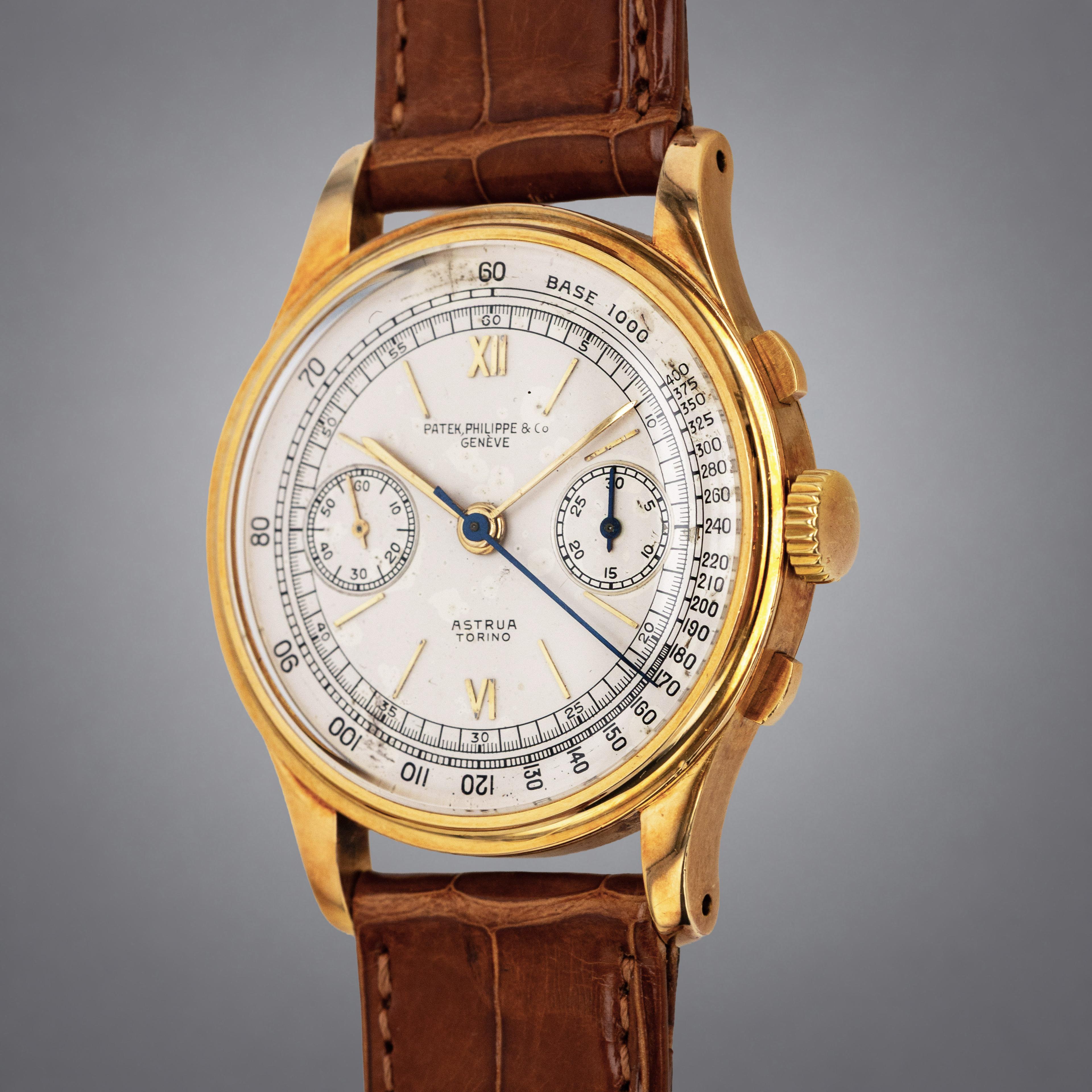
530J, “Astrua Torino”, Exceptionally Rare, Large Chronograph, Yellow Gold (18-carat)
Estimate: $200,000 – 400,000
- Brand
- Patek Philippe, Geneva
- Model
- Chronograph
- Retailed by
- Astrua Torino
- Year
- Circa 1938
- Reference
- 530J
- Movement
- No. 862145
- Calibre
- 13-130, manual-winding, 23 jewels
- Case
- No. 506218
- Materials
- Yellow gold (18-carat)
- Bracelet
- Leather strap
- Buckle
- Yellow gold (18-carat) pin-buckle
- Dimensions
- Ø 36.5 mm
- Thickness
- 11.6 mm (approx.)
- Signature
- Dial, case and movement
- Accessories
- Extract from the Archives
An Exceptionally Rare Yellow-Gold Chronograph Double-Signed “Astrua Torino” Among Patek Philippe’s early wrist chronographs, Reference 530 occupies a distinguished position for its generous proportions, mechanical sophistication and remarkably limited production. Launched on 14 August 1937 and produced until the early 1960s, it represents a larger interpretation of the celebrated Reference 130, increasing the case diameter from approximately 33–34 mm to 36–37 mm. Its substantial dimensions, unusually generous for the period, contributed to its enduring appeal among collectors. Produced predominantly in yellow gold, with rarer examples in pink gold and stainless steel, Reference 530 remains one of the manufacture’s most elusive vintage chronographs. Only 111 examples were produced by 1951, including seven in stainless steel, with total production estimated at approximately 140 pieces through the early 1960s. The yellow-gold cases were manufactured by the Genevan casemaker Croisier, while the dials were supplied by Stern Frères. The current example, dating to 1938, features a substantial 36.5 mm yellow-gold (18-carat) case with a stepped bezel, elegantly downturned lugs and rectangular chronograph pushers. Its attractive silvered dial displays applied gold Roman numerals at 12 and 6 o’clock, faceted baton hour markers, polished gold hands and two recessed subsidiary registers. An outer tachymeter scale lends further technical character to its balanced composition. Of particular significance is the distinguished double signature “Patek Philippe & Co. Genève” and “Astrua Torino”, identifying its association with the prestigious Turin retailer, one of Patek Philippe’s prominent Italian clients. The present watch is understood to be one of only two yellow-gold examples observed bearing this double signature, lending considerable rarity and historical interest to an already scarce reference. Powering the watch is the manual-winding Calibre 13-130, developed from a 13-ligne Valjoux ébauche extensively modified by Patek Philippe. First offered in April 1938, the calibre features 23 jewels, a traditional column-wheel chronograph mechanism, subsidiary seconds at 9 o’clock and a 30-minute counter at 3 o’clock. Its refined construction and traditional finishing reflect the manufacture’s technical accomplishments during this formative period of wrist chronograph production. An Extract from the Archives dated 2017 confirms that the present watch was manufactured in 1938 and sold in 1939, originally fitted with a silvered dial, raised hour-markers and tachymeter scale. Combining rare retailer provenance, elegant oversized proportions and the historical significance of Patek Philippe’s early chronograph development, this exceptional Ref. 530J stands as a particularly compelling example of the manufacture’s pre-war watchmaking. ––
Biography
Patek Philippe, Master of all Horological Complication Patek Philippe is a prestigious Swiss watch manufacturer, renowned for its luxury watches and exceptional craftsmanship. Founded in 1839 in Geneva by Antoine Norbert de Patek (1812-1877) and François Czapek (1811-after 1869), the company quickly established its reputation as a manufacturer of superior watches. In 1844, following the National Exhibition of French Industrial Products in Paris, Antoine Norbert de Patek met Jean-Adrien Philippe (1814-1894), a young French watchmaker. In 1845, after Czapek’s departure, the two men concluded a commercial agreement and introduced numerous innovations in the field of watchmaking, notably a keyless-winding and time-setting system for which Philippe received a Bronze medal. In 1851, the company was renamed “Patek, Philippe & Cie – Fabricants à Genève”, and over the decades became synonymous with exclusivity, precision and technical perfection as evidenced by the wristwatch made for the countess Hungarian Koscowicz (1868), patents for a precision regulator (1881), a perpetual calendar mechanism (1889), a double chronograph (1902) and all the brand’s creations, whether pocket watches or watches. bracelets with horological complications. From the early 1900s until 1927, Patek Philippe introduced a unique business model. The house’s main distributor based in Rio de Janeiro in Brazil, “Gondolo & Labouriau” sold more than a third of the production at the time thanks to a cleverly orchestrated sales system. These timepieces, known as “Chronometro Gondolo”, are collector’s items famous both for their very high technical quality and for their unique history. The watches were sold at the time, exclusively to members of a very select clubs called the “Gondolo Gang” which have 180 members. Being part of these collector’s clubs was, at the beginning of the 20th century, a distinctive sign of success in Brazilian society. According to an ingenious raffle system, each member of the club agrees to buy a watch for the amount of 790 Swiss francs divided into 79 weekly instalments of 10 francs. During these 79 weeks of repayment, a weekly draw is organized where the winner is released from the balance of his debt. The first winner pays 10 francs for their watch, the second 20 francs, etc. The earlier you buy your watch, the cheaper it costs, provided you win this lottery. Echoing this episode in its history, the “Gondolo” collection was reinterpreted in 1993 with shaped watches. In 1932, Patek Philippe became a family business when the Stern family, already involved in the production of dials for the brand, bought the company. It is also the year of the launch of a model that will become the brand’s flagship collection: the “Calatrava”. Even today, it contributes to the success and reputation of the company. Among the emblematic models of Patek Philippe, we can also mention the “Ellipse” (1968) with its elliptical-shaped case, at the crossroads of the circle and the rectangle which is inspired by the “golden ratio”; the “Nautilus” (1976), a sporty and luxurious watch whose case is inspired by a porthole; or watches for women, such as the “Twenty-4” collection (1999), which combines feminine elegance with horological precision. Since its creation, the brand has been driven by a spirit of innovation. In 1989, Patek Philippe released a very complex model to celebrate its 150th anniversary. Named “Calibre 89”, the watch is equipped with 33 horological complications and its calibre is made up of 1 728 parts. Eleven years later, in order to celebrate the second millennium, the brand released the “Star Calibre 2000” model, a double-sided pocket watch with 21 horological complications. Finally, the year 2002 saw the launch of the “Sky Moon Tourbillon” model, the most complicated double-sided wristwatch ever produced by the house. Benchmark precision instruments, Patek Philippe watches are also recognized by collectors for being objects of art whose beauty reflects perfection. For many years, Patek Philippe has strived to preserve all the high craftsmanship professions linked for more than four centuries to the decoration of timepieces. This is how exceptional contemporary creations come into being – pocket watches, wristwatches, or clocks –, most often unique pieces, which highlight all these skills that are threatened with disappearance. This transmission value is essential for the brand. Patek Philippe can be proud of having filed more than 70 patents since its creation, notably for a Gyromax balance-wheel (1949), mechanical watches with time zones (1959), a mechanical movement with peripheral rotor (1964), an indicator mechanism of the date of Easter (1985), an annual calendar (1996) or even an astronomical representation mechanism (2000). These technical innovations have largely contributed to advancing the horological industry while contributing to the brand’s reputation for excellence. Today, Patek Philippe is a watch brand that continues to produce superior quality watches that are admired by watch enthusiasts around the world. -- Key Dates • 1839: foundation of “Patek, Czapek & Cie2 by Antoine Norbert de Patek and François Czapek in Geneva. • 1845: following the departure of Czapek, the company becomes “Patek & Cie”. Arrival of Jean-Adrien Philippe, a young French watchmaker who invented a keyless-winding and time-setting mechanism. • 1851: the company is now called “Patek, Philippe & Cie”. The house presented its products at the Universal Exhibition in London, the first event of its kind. • 1868: manufacture of the first wristwatch for the Hungarian Countess Koscowicz. • 1901: the company becomes a public limited company. • 1932: acquisition of a majority of shares by the Stern family, one of the manufacturers of dials for the brand. Launch of the reference 96 which will later be called “Calatrava”. • 1949: patent for the “Gyromax” balance-wheel. • 1953: launch of the self-winding “Calibre 12-600 AT”. • 1968: launch of the first “Golden Ellipse” model, the Ref. 3548. • 1976: launch of the first “Nautilus” sports watch, the Ref. 3700/1 in stainless steel. • 1989: 150th anniversary of the manufacture. Launch of various commemorative watches and the “Calibre 89”, at the time the most complicated watch ever made, with 33 horological complications. • 1996: establishment of the new factory in Plan-les-Ouates, near Geneva. • 2001: inauguration of the Patek Philippe Museum in Geneva, exhibiting a remarkable collection of antique watches, horological art and enamel (1500-1850), and Patek Philippe watches. • 2019: 180th anniversary of the manufacture. -- Iconic models and current collections • “Calatrava”: this collection is emblematic of the manufacture. These watches are distinguished by their clean and classic design, with a round case and a minimalist dial. The “Calatrava” embodies timeless elegance and represents the brand’s traditional watchmaking know-how. • “Nautilus”: this model is one of the most emblematic models of the manufacture. Designed by Gérald Genta, it is high-end sports watch recognizable by its octagonal case and its integrated bracelet. It offers a perfect balance between sportiness and elegance. • “Aquanaut”: this collection is another line of sports watches from Patek Philippe. These watches are characterized by its octagonal case and rubber strap. It offers a contemporary aesthetic and high resistance to hydrostatic pressure. • “Twenty-4”: this collection is specially designed for women. These watches combine classic elegance with contemporary style. Initially equipped with a rectangular-shaped case and offering a selection of models with diamonds and steel or gold bracelets, they are now round in shape.