
 1 / 10
14 Nov 2026
19 / Breguet
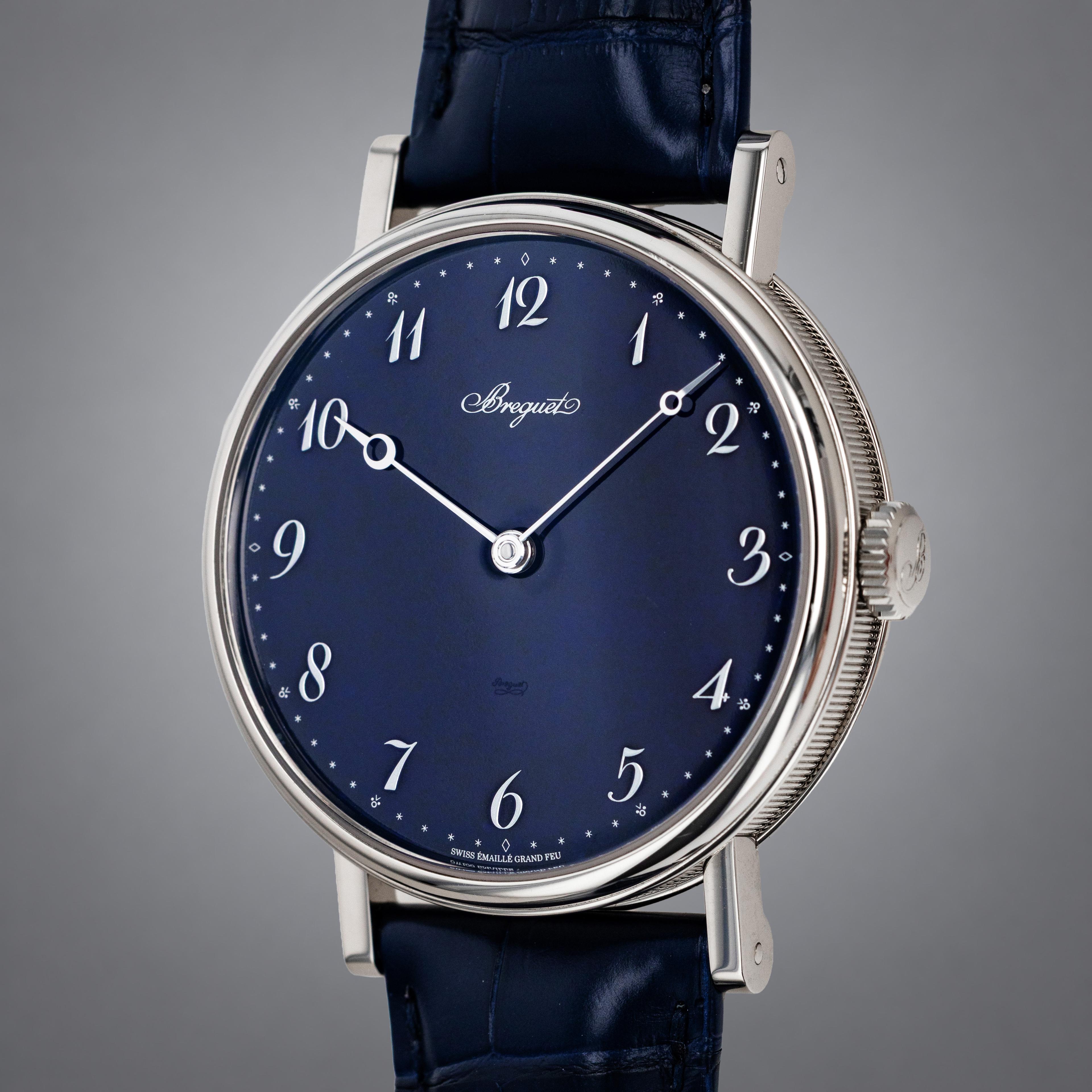
7637BB/2Y/9ZU, Minute-Repeater, Blue Grand Feu Enamel Dial, White Gold (18-Carat)
Estimate: $180,000 – 260,000
- Brand
- Breguet
- Model
- Classique Répétition Minutes
- Year
- 2020
- Reference
- Breguet 7637BB/2Y/9ZU
- Movement
- No. 6732
- Calibre
- 567/2, manual-winding, 31 jewels
- Case
- No. 3600AW
- Material
- White gold (18-carat)
- Bracelet
- Leather strap
- Buckle
- White gold (18-carat) deployant clasp
- Dimensions
- Ø 43 mm
- Thickness
- 12.4 mm
- Signature
- Dial, case and movement
- Accessories
- Presentation box with key and Certificate of Origin booklet.
Breguet Reference 7637BB/2Y/9ZU – The Art of the Minute Repeater The Breguet Classique Répétition Minutes Reference 7637BB/2Y/9ZU represents an exceptional union of traditional craftsmanship and one of haute horlogerie’s most prestigious complications—the minute repeater. Housed in an elegant 43 mm white gold (18-carat) case, the watch features Breguet’s signature fluted caseband and straight lugs. Its striking blue Grand Feu enamel dial is beautifully complemented by Breguet Arabic numerals and traditional open-tipped hands, creating a refined and unmistakably classical appearance. At its heart is the manually wound Calibre 567.2, comprising 358 components and equipped with a sophisticated minute repeater mechanism that strikes the hours, quarters and minutes on demand. Combining a captivating enamel dial, precious-metal construction and exceptional mechanical complexity, the Reference 7637BB/2Y/9ZU is a superb expression of Breguet’s historic mastery of complicated watchmaking. --
Biography
Breguet, the Greatest Watchmaker Breguet is a Swiss watch manufacturer founded by Abraham-Louis Breguet (1747-1823) in 1775 in Paris, France. He is considered one of the greatest watchmakers of all time and is known for his major contributions to horology. From the start, he focused on technique rather than decoration, thus creating a new style of watch in which beauty is purely functional; a style that soon convinced all European courts. Breguet timepieces outperform all other products in which decoration compensates for a technical weakness. The man revolutionized the field of watchmaking and some of the most important and enduring inventions are attributed to him, including the hairspring that bears his name, the tourbillon regulator, the natural escapement, the self-winding mechanism, the anti-shock system, the “sympathique” clock accompanied by a watch that adjusts and winds the latter and the use of hammers and gongs used in almost all minute-repeater watches made since. These technical advances greatly improved the precision and reliability of watches of the time and earned Breguet international fame and the title of “father of modern watchmaking”. Its clientele includes influential figures of the time, including members of many royal and princely families in Europe, aristocrats and political figures (the Bonaparte family) as Breguet watches are highly prized for their exceptional quality, elegant aesthetics and their technical innovation. Abraham-Louis Breguet also revolutionized the style and aesthetics of late 18th century watches, creating, for example, his own numerical typography (known as “Breguet” numerals) still used by many watch brands today. He also transformed the marketing of his watches by introducing the subscription sales system. The concept is to start producing watches when a sufficient quantity is ordered. To maintain quality while reducing the price, Breguet simplified the movement. Over the years, the brand has remained faithful to the heritage of its founder by producing fine watchmaking watches with impeccable finishes. It is known for its timeless classic style, characterized by sleek dials, apple-shaped hands (known as “Breguet”) and round-shaped cases. From a technical point of view, the company is at the forefront of the watch industry in terms of research and development. The company continues to innovate by introducing new complications and using state-of-the-art materials. The descendants of Breguet have inherited the technical genius of their patriarch. His fourth-generation descendant, Louis-Charles Breguet (1880-1955), founded Breguet Aviation, now incorporated into Dassault Aviation. At the start of the 20th century, the brand designed and manufactured on-board instruments for the pioneers of aviation, thus contributing to the progress of aeronautics. Later, the “Type XX” watch created in 1954 for the French Air Force, is a pilot’s wristwatch that quickly became an icon in the world of aviation. Since 2000, Breguet has had a dedicated museum located Place Vendôme in Paris with more than hundred historic Breguet watches on display. Today, Breguet is part of Swatch Group, one of the largest luxury groups in the world, while retaining its distinctive identity and status as a premium brand. Breguet watches continue to represent watchmaking excellence and are loved by collectors and watch enthusiasts around the world. -- Key dates • 1775: Abraham-Louis Breguet sets up on his own, Quai de l’Horloge on the Ile de la Cité in Paris. The house is ideally located in a district where goldsmiths, manufacturers of sundials and other scientific instruments, manufacturers of watch-cases, etc., are busy. • 1780: development of the self-winding “perpétuelle” watch, the first major success in Breguet’s career. He was the first to find, with his oscillating weight watch, a formula for making a reliable automatic watch. • 1795: first description of the “sympathique” clock. Development of the perpetual calendar, the Breguet hairspring and the ruby cylinder. • 1796: launch of the “Montre souscription” (subscription’s watch) by means of an advertising prospectus (1797), its marketing is based on the principle of subscription, with the payment of a quarter of the price when ordering. • 1799: invention of the “à tact” (tactile) watch equipped with a system designed by Breguet allowing the time to be read by touch. • 1810: production of the first wristwatch, commissioned by the Queen of Naples, Caroline Murat, younger sister of Napoleon I, Emperor of the French. • 1830: development of the keyless winder allowing the hands to be set and the watch to be wound. • 1926: patents for watches without hands, with jumping hours and a rotating dial. • 1954: delivery to the French army of “Type XX” chronographs, pilot’s watches equipped with a chronograph with “retour en vol” (fly-back device), which allows instant return to zero of the chronograph function by simply pressing the lower pusher, simplifying thus the operations of the pilot or the crew members and offering the possibility of carrying out several consecutive time measurements. • 1972: presentation of the “Classic” line. • 1999: acquisition of the brand by Swatch Group. • 2005: launch of the “Tradition” line. • 2008: reissue of the “Marie-Antoinette” watch based on archive plans. -- Iconic models and current collections • “Classic”: this collection represents the classic and timeless aesthetic of the brand. These watches are characterized by their sleek design, their hand-guilloché dial, their apple-shaped blued steel hands (known as “Breguet”) and their slim case. • “Marine”: this collection is inspired by historic Breguet marine timekeeper. These watches are designed for water sports enthusiasts and are known for their elegance and functionality with luminous dials, Roman numeral indexes and sturdy cases. • “Tradition”: this collection highlights the traditional horological art and technical expertise of the brand. These watches sport a skeleton dial that exposes the movement, providing a detailed view of the internal components. They combine innovation and heritage. • “Type XX”: this collection is dedicated to pilot’s watches and the chronograph. These watches are inspired by Breguet’s historical military models and are characterized by their functionality, readability and robustness and are appreciated by lovers of sports watches. • “Reine de Naples”: this collection is a range of very elegant women’s watches. These watches are inspired by the first wristwatch created for the Queen of Naples in 1810. They are distinguished by their oval shape, refined complications and feminine aesthetics. • “Heritage”: this collection offers a modern interpretation of historical pocket watches. These watches are distinguished by their asymmetrical case, their off-centred dial and their horological complications combining tradition and innovation. --