
 1 / 10
14 Nov 2026
20 / Rolex
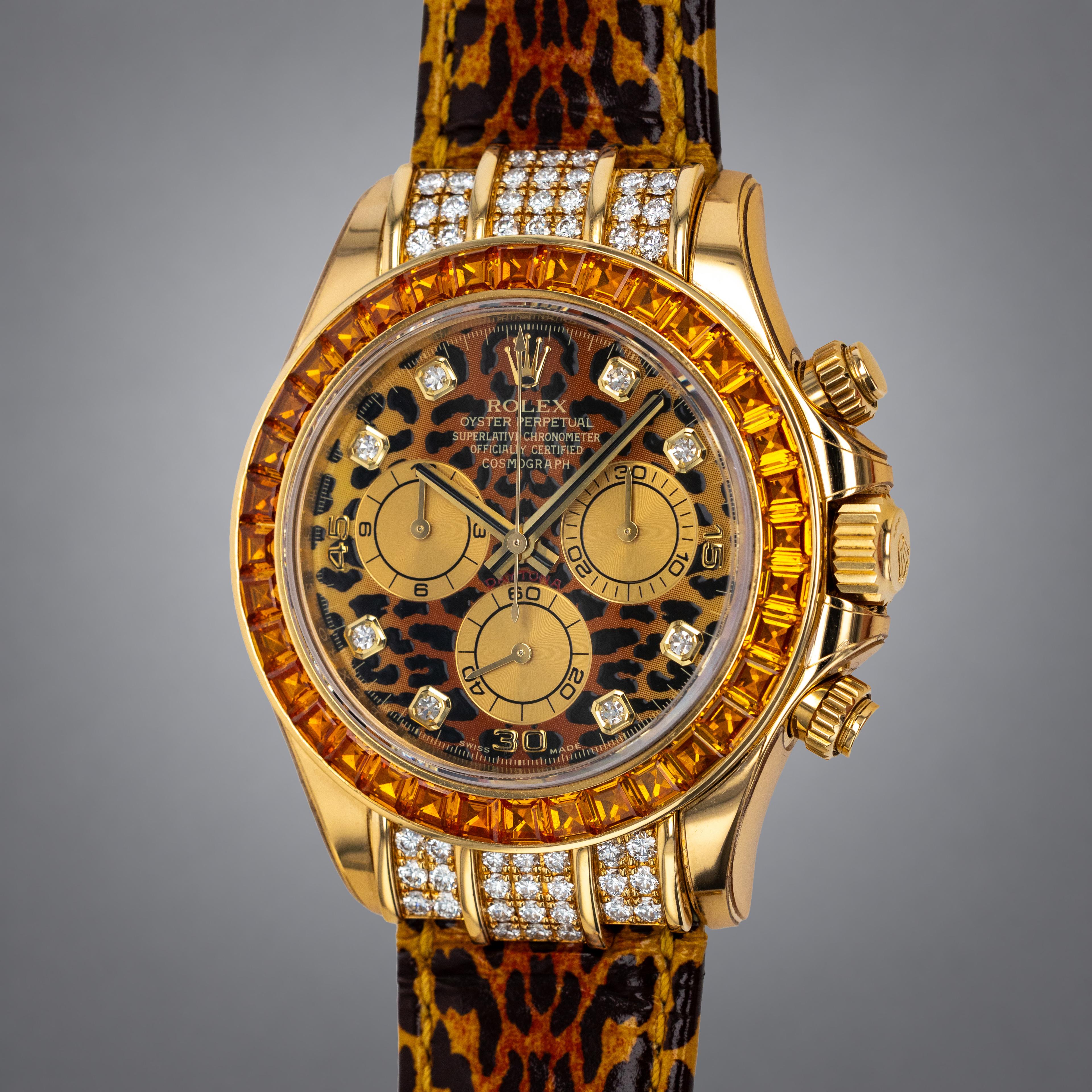
116598, SACO-Cosmograph Daytona, "Leopard", Yellow gold (18-carat)
Estimate: $80,000 – 120,000
- Brand
- Rolex, Geneva
- Model
- SACO-Cosmograph Daytona
- Year
- Circa 2004
- Reference
- 116598
- Movement
- No. C0343819
- Calibre
- 4130, self-winding, 44 jewels
- Case
- No. V049740
- Materials
- Yellow gold (18-carat)
- Bracelet
- Leopard-pattern leather strap
- Buckle
- Yellow gold (18-carat) folding clasp
- Dimensions
- Ø 40 mm
- Thickness
- 12.5 mm
- Signature
- Dial, case and movement
- Accessories
- Box, booklet, Rolex service card, Rolex tag & Guarantee card
Rolex Reference 116598 SACO – The Iconic “Leopard” Daytona Introduced at the Basel Watch Fair in 2004, the Rolex Cosmograph Daytona Reference 116598 SACO, affectionately nicknamed the “Leopard”, represents one of the manufacture's boldest and most unconventional creations. Combining exceptional gemstone craftsmanship with the legendary Daytona chronograph, the reference exemplifies Rolex's adventurous approach to high jewellery watchmaking. Crafted in yellow gold (18-carat), it features a magnificent bezel adorned with 36 baguette-cut orange sapphires, complemented by diamond-set lugs. Its extraordinary leopard-print dial, enhanced by diamond hour markers and three champagne-gold subsidiary registers, creates a striking visual composition, further emphasised by the matching leopard-pattern leather strap. At its heart lies the celebrated automatic Calibre 4130, Rolex's in-house chronograph movement, featuring a column-wheel mechanism, vertical clutch and approximately 72 hours of power reserve. The movement combines technical sophistication with the manufacture's renowned chronometric precision. Distinguished by its extravagant gemstone setting, unmistakable leopard motif and prestigious Daytona heritage, the Reference 116598 SACO has become one of the most recognisable and unconventional gem-set Rolex wristwatches. Its distinctive design and unusual configuration make it particularly appealing to collectors seeking rare and visually striking examples of contemporary Rolex watchmaking. --
Biography
Rolex, Passion for Perfection Rolex is a world-renowned Swiss watch manufacturer, founded in 1905 by Hans Wilsdorf (1881-1960). The history of Rolex is closely linked to the innovative and visionary spirit of its founder who had a passion for horology and who believed in the possibility of creating precise and reliable wristwatches. In 1905, at the age of 24, he founded the company “Wilsdorf & Davis” with his brother-in-law, Alfred Davis, in London, specializing in the distribution of watches. At the time, wristwatches were still considered unreliable, but Hans Wilsdorf was convinced that they would become precision instruments, both elegant and reliable. To guarantee the reliability of these resolutely innovative pieces in the eyes of the public, he equips them with small, highly precise movements, manufactured by a Swiss factory located in Bienne / Biel (Canton of Bern / Berne). At the same time, he opened a technical office in La Chaux-de-Fonds (Canton of Neuchâtel). In 1908, he registered the “Rolex” brand with the company’s branch located in La Chaux-de-Fonds, which was then transferred to Bienne / Biel. It focuses on the development of high-precision wristwatches. Very quickly, the company experienced success: in 1910, it was a Rolex watch which received the first certificate granted to a wristwatch by the Bureau officiel de contrôle de la marche des montres (Official Office for the Control of Watch Movements) in Bienne / Biel. It has an 11-line movement. Four years later, in 1914, it was the turn of the Kew Observatory, in Great Britain, to issue a Class “A” rate Bulletin to a Rolex wristwatch. In 1919, Hans Wilsdorf transferred the Rolex offices to Geneva, 18, rue du Marché, and founded the company “Montres Rolex S.A.”. In 1926, a major step was taken with the creation of the first waterproof and dustproof watch. Called “Oyster”, this watch with its hermetic case like a safe guarantees optimal protection of the movement. This revolutionary model allows the brand to become a reference in the field of waterproof watches. Thanks to a case equipped with a patented system of screwed bezel, case-back and winding-crown, the hermetically sealed “Oyster” offers optimal protection to the movement. The “Oyster” thus represents a complete horological concept, including the case and the movement with a global perspective of improving chronometric performance. If Hans Wilsdorf presents the “Oyster” as “la plus importante invention de ces dernières années concernant les montres” (the most important invention of recent years concerning watches), it is because its waterproofness also brings a major advance in terms of maintaining precision over time. In 1928, Rolex created the first “Prince” model which was produced until 1935. This model enjoyed immense success thanks in particular to its chronometric prowess. Avant-garde in its rectangular shape, the “Prince” stood out, at the time, for the performance of its movements. It is the subject of a patent for the positioning of the hands in two superimposed dials, one for the hours and minutes, the other for the seconds. Rolex is also a pioneer in the development of the self-winding movement, with its central rotor introduced in 1931. This patented system, called “Perpetual”, allows Rolex watches to wind automatically thanks to the movements of the wearer’s wrist, thus eliminating the need daily manual winding. Since 1927, Rolex has associated its renowned precision and excellence with the world of sport by becoming a sponsor of various leading sporting events. This new adventure begins with the “24 Hours of Daytona”, a 24-hour car race, which today bears the name “Rolex 24 at Daytona”. In 1950, the increasingly prestigious brand was elected the official timing company of the Wimbledon tennis tournament. Rolex will even go so far as to launch watches dedicated to sporting exploits such as mountaineering, aviation or scuba diving such as during the first ascent of Everest or in the depths of the oceans. From now on, Rolex and the world of sport are privileged partners. Rolex owes its fame to its precision watches, but also to its avant-garde spirit from which it has never departed since its creation. Indeed, the epic continues with, in 1945, the release of the “Oyster Perpetual Datejust” model, the first watch to indicate the day of the month. Then, under the direction of André Heiniger, Swiss business leader who succeeded Wilsdorf, other versions of the “Oyster” were created, such as the “Oyster Perpetual Submariner” which withstands depths of one hundred meters or even the “Oyster Perpetual GMT-Master” on which you can read the time in two different time zones. Today, Rolex is considered one of the most prestigious and iconic luxury watch brands in the world. It offers a wide range of models, ranging from diving watches to dress watches, including sports watches, with its emblematic models such as the “Datejust” (1945), the “Day-Date” (1956), the “Submariner” (1953), the “GMT-Master” (1955) and the “Cosmograph Daytona” (1963). Rolex is widely recognized for its quality, precision, and prestige in the watch industry. Each watch is manufactured with great attention to detail, using high-quality materials and benefiting from rigorous quality control. The brand places great importance on the precision and reliability of its watches, and each watch is chronometer certified, attesting to its precision certified by rigorous testing. Rolex embodies the perfect alliance between aesthetics, functionality, and durability. His watches are symbols of status and success and are sought after by collectors and watch enthusiasts around the world. -- Key dates • 1905: Hans Wilsdorf founds “Wilsdorf & Davis” in London, England, which later became Rolex. Initially, the company focused on the distribution of watches, but Wilsdorf aimed to create precision wristwatches. • 1910: Rolex becomes the first watch brand to receive official certification from the Bienne / Biel Bureau officiel de contrôle de la marche des montres (Official Office for the Control of Watch Movements). • 1926: invention of the “Oyster” waterproof case, which is the first waterproof and dustproof watch case for a wristwatch. This revolutionary innovation reinforces Rolex’s reputation for robustness and resistance to the elements. • 1931: invention of the “Perpetual” rotor, the first self-winding system with a central oscillating weight. This system uses the natural movement of the wrist to wind the watch, eliminating the need for manual-winding. • 1945: launch of the “Datejust”, the first self-winding chronometer wristwatch to display the date in an aperture on the dial. This prestigious watch comes with the “Jubilee” bracelet created especially for it and has a fluted bezel: a Rolex watch recognizable at first glance. It is the mainstay of the “Oyster Perpetual” collection. • 1953: launch of the “Submariner” watch, the first diver’s watch waterproof to 100 metres. This watch became iconic in the field of scuba diving and set the standards for later dive watches. • 1956: presentation of the “Day-Date” watch, which displays not only the time, but also the entire day of the week. It quickly became a reference watch for influential people and heads of state. • 1967: introduction of the calibre 1575 with the “GMT-Master” function, which displays a second time zone. -- Iconic models and current collections • “Datejust”: a timeless Rolex classic. It is characterized by its dial with the date displayed at 3 o’clock, its classic-shaped case and its “Jubilee” or “Oyster” bracelet. It is a versatile watch, suitable for formal or casual occasions. • “Day-Date”: also known as “President”, it is a prestigious watch. It is characterized by its dial displaying the day of the week and the date, its precious metal case and its “President” bracelet. • “Explorer”: this model embodies the spirit of adventure and discovery. It is designed to withstand extreme conditions and offers optimal readability. It is a simple, elegant and functional watch. • “Submariner”: legendary diving watch, appreciated for its robustness, reliability and functionality. It features a unidirectional rotating bezel and high-water resistance. • “GMT-Master”: it is a watch designed for travellers. It has a GMT function, allowing two-time zones to be displayed simultaneously. It is also appreciated for its distinctive aesthetic, with a two-tone bidirectional rotating bezel. • “Daytona”: this is Rolex’s emblematic chronograph watch. It is often associated with the world of motor sports and is appreciated for its sporty design and its readable dial. --