
 1 / 9
14 Nov 2026
31 / Cartier
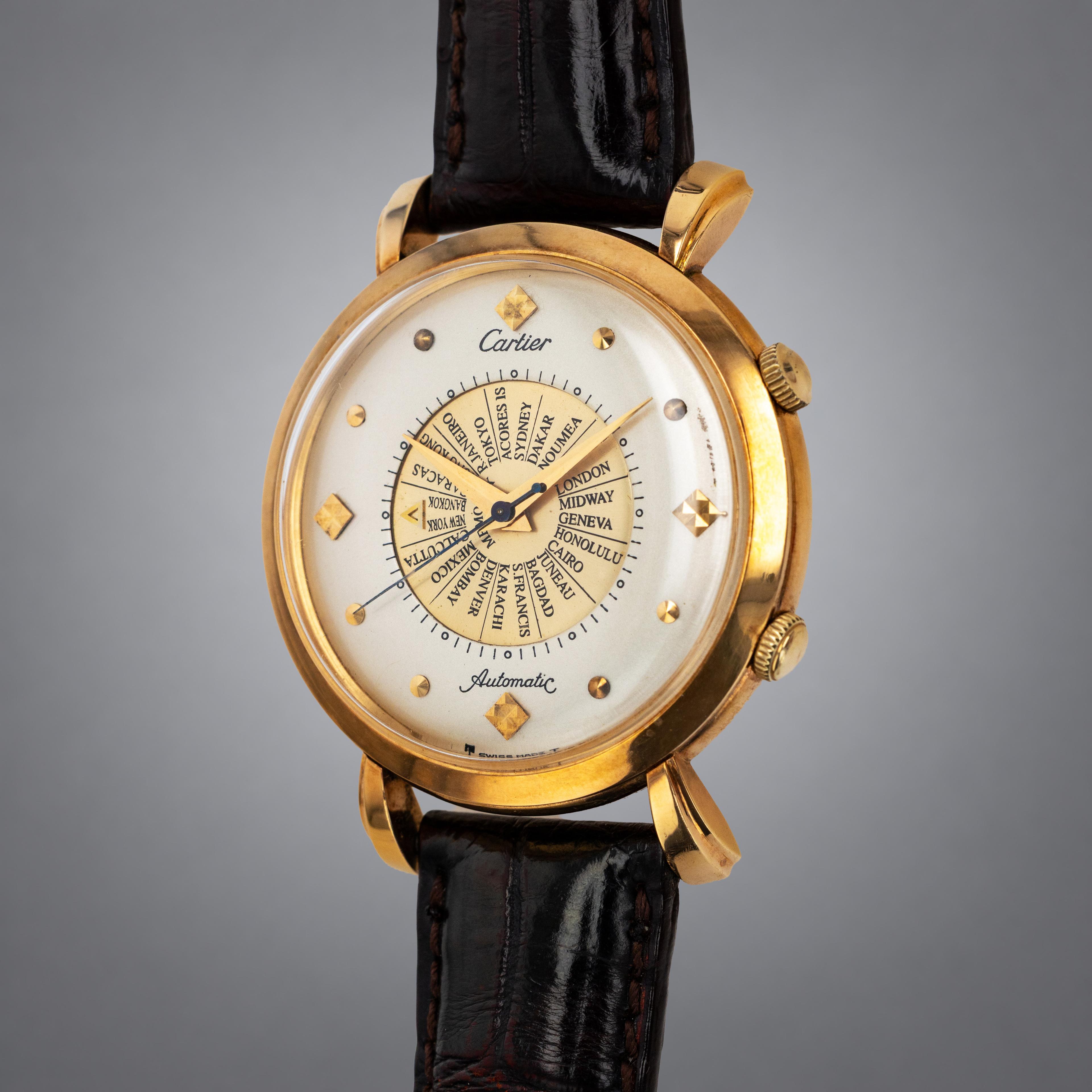
A Possibly Unique, World Time, Self-Winding, Alarm Function, Yellow Gold (18-Carat)
Estimate: $200,000 – 400,000
- Brand
- Cartier
- Model
- “Memovox" World time indicator with alarm function
- Year
- Circa 1960
- Movement
- No 1 205 063
- Calibre
- B 815, 14''', self-winding, 17 Jewels
- Case
- No. 442 / 26 / 156 (by Monnier & Cie, La Chaux-de-Fonds)
- Materials
- Yellow gold (18-carat)
- Bracelet
- Leather strap
- Buckle
- Gilt-metal pin-buckle
- Dimensions
- Ø 39 mm
- Thickness
- 12 mm
- Signature
- Cartier signed dial, case and movement
- Accessories
- Cartier Service Invoice, dated 2024
About this watch This Cartier wristwatch combines an alarm function with a world time indication. Dating from circa 1960–1965, it brings together Jaeger-LeCoultre’s “Memovox” alarm mechanism and a central disc bearing the names of twenty-four cities around the world. In the early 1960s, Cartier Paris, Cartier London and Cartier New York were managed autonomously by different members of the Cartier family. Their legal separation took place gradually over the course of the decade. Cartier then commissioned its watches from several specialist manufacturers, including Patek Philippe, Audemars Piguet, Jaeger-LeCoultre and Baume & Mercier. Marketed by Cartier New York, this watch is powered by the self-winding calibre B 815, made by Jaeger-LeCoultre in Le Sentier, in the Vallée de Joux. Its 18-carat yellow gold case was made by Monnier & Cie in La Chaux-de-Fonds, in the Neuchâtel Mountains. The watch thus illustrates a common practice of the period, whereby Cartier’s design and marketing were combined with the expertise of specialist watch manufacturers. The alarm function belongs to the history of the “Memovox”. Introduced in 1950, it brought an audible reminder to the wrist, whether to signal an appointment or the time to wake up. The first version was powered by the manually wound calibre 489, beating at 18,000 vibrations per hour. In 1956, Jaeger-LeCoultre introduced calibre 815, its first self-winding movement with an alarm. It featured two independent barrels, one for timekeeping and the other for the alarm, together with a peripheral oscillating weight known as a “bumper” rotor. At the preset time, a hammer produces the alarm by striking inside the case. The family subsequently evolved with calibre 825, which added a date, followed by calibres 875 and 876. Calibre 912 introduced a hacking seconds mechanism. In 1969, calibre 916 adopted a central rotor and a frequency of 28,800 vibrations per hour. The B 815 in this Cartier belongs to the first generation of self-winding “Memovox” movements. The city disc adds a world time indication to the alarm function. From 1958, Jaeger-LeCoultre offered “Memovox International” models bearing the names of cities corresponding to the world’s time zones. By setting the alarm to local time and positioning the disc accordingly, the wearer could consult the corresponding times in the other cities. On this watch, the crown at 11 o’clock winds the alarm and sets the central disc; the crown at 1 o’clock winds the movement and sets the time. The disc therefore serves both to set the alarm and to follow the time in the principal cities of the world. The “VXN” marking on the movement identifies its passage through the American import channel. This code was associated with LeCoultre and Vacheron & Constantin watches distributed in the United States by Longines-Wittnauer. Its use for Vacheron & Constantin is documented from 1938 and for LeCoultre from 1939. It indicates a shared distribution network. Finally, the “T SWISS T” marking at six o’clock indicates the use of tritium-based luminous material. Small dots on the alarm track and the arrow-shaped index on the central disc were luminescent, making the preset alarm time legible in the dark. These elements no longer luminesce today; the dial marking preserves evidence of their original function. The watch is accompanied by a Cartier service invoice dated 2024, attesting to its originality. –– US Import Codes At the beginning of the 20th century, new customs regulations relating to horology were applied in the United States of America, involving new taxes on the import of watches. A code is assigned to the American importer. It may also be the US subsidiary of a foreign manufacturer. The result is a long list of three-letter codes that are stamped on Swiss and European watch movements. Examples include the following brands: • “AYP”, for Audemars Piguet • “BOL”, for Lemania Watch Co. • “EXU”, for European Watch & Clock Co. (the Cartier manufacturer) • “JXJ”, for Jules Jürgensen Corp. • “LXJ”, for LeCoultre puis Jaeger-LeCoultre • “OXG”, for Omega • “PXP”, for Patek Philippe • “ROW”, for Rolex and Tudor • “VXN”, for Vacheron & Constantin (and at one time for LeCoultre) • “ZFX”, for Zenith The “HOX” code regularly used by I.W.C. (International Watch Co.) and Universal Genève was also used by Patek Philippe in the 1950s and 1960s. ––
Biography
Cartier, Timeless Elegance Cartier is a French luxury manufacturer specializing in the creation of luxury jewellery, watches, perfumes and accessories. Founded in 1847 by Louis-François Cartier (1819-1904) in Paris, France, the brand has become one of the most iconic names in the jewellery and watchmaking industry. Initially, the jewellery boutique was located at number 31, rue Montorgueil. From the beginning, it is a craftsman’s love for details, for authentic materials and for the noblest creations, which elevates his craftsmanship to the rank of art. For Cartier, the road to success passes through many neighbourhoods. First the Palais Royal; then the Boulevard des Italiens, where a cosmopolitan clientele, including the first Russian patrons, discovered not only jewellery but works of art, pocket watches, and from 1888 jewellery wristwatches. At that time, platinum, considered a new metal with multiple virtues, opened up the field of possibilities. In 1872, Louis-François Cartier involved his son Alfred (1841-1925). Two years later, the latter took over the management of the store and trained his son Louis-Joseph Cartier (1875-1942) to become a jeweller, thus preparing the third generation to run the company. With the new century comes new momentum for Cartier. In 1898, Alfred made his eldest son, Louis, his partner, renaming the company “Alfred Cartier & Fils” and moving a year later to 13, rue de la Paix. This new boutique will become the legendary place for jewellery creations for the entire 20th century. Louis, then aged 23, was then joined in business by his younger brothers Pierre (1878-1964) and Jacques (1884-1941). Over the years, Cartier jewellery has been appreciated by influential figures of the time, including royalty, aristocrats, celebrities and artists in Europe and the United States. Faced with this success, the company expanded internationally by opening branches in London (1902) and New York (1909) where its creations enjoyed great success. At the turn of the century, Louis-Joseph Cartier took the company to a new level of innovation and imagination. A jeweller at heart, he creates adornments set with diamonds and other precious stones mounted on platinum which are inspired by artistic trends (Louis XVI or neo-classic fashion, Art Nouveau or Art Deco) which follow one another but also by his various travels (Russia, Egypt or America) following his inspiration and constantly seeking new ways of expression. In addition to jewellery, Cartier is also a pioneer in the field of watchmaking. The brand develops high-quality watch movements and creates iconic watches. In 1904, Cartier created the first wristwatch for his friend Alberto Santos-Dumont (1873-1932), an aviation pioneer. The “Santos” watch quickly became a symbol of elegance and innovation, and it is still produced today. The “Tank” model, inspired by the shapes of tanks, also became a watchmaking classic and contributed to the international reputation of Cartier, as did the “Ballon Bleu” watch, born in 2007, and worn indiscriminately by women as by men who experienced rapid success and rose to the rank of icon of the house or the panther who became the emblematic animal of the House; a racy and indomitable animal whose symbolism and elegance have reigned over the brand’s creativity since its first appearance in 1914. The “Pendules mystérieuses” (mysterious clocks) are another astonishing marvel of Cartier horological art. They were developed from 1913 in collaboration with the exceptional watchmaker Maurice Couët (1885-1963), based on an idea first realized by the French watchmaker Jean-Eugène Robert-Houdin (1805-1871). These clocks will become one of the emblems of Cartier. This is a true watchmaking prodigy: the hands are not connected to the movement but each fixed to a rock crystal disc whose serrated metal edge activates a rack hidden in the frame. They thus give the illusion of magically floating in the clock, from the front and back, the movement being hidden in the base of the clock. When Jacques died in 1941 and Louis in 1942, Pierre Cartier was given the task of perpetuating the business. In 1945, he took over as head of Cartier Paris and New York, and Jacques’ son, Jean-Jacques (1919-2010), took over as head of Cartier London. Over the years, Cartier has expanded its offering to include accessories, fragrances, and leather goods. The company also continues to develop its network of luxury boutiques around the world. In 1983, the brand was acquired by Richemont Group, which allowed it to benefit from significant financial support. Today, Cartier is a world-renowned luxury brand, appreciated for its historical heritage, elegant and refined design and exceptional craftsmanship. The brand is recognized for its fine jewellery designs, using the highest quality gemstones and materials to produce unique and luxurious pieces. Embodying timeless elegance and understated luxury, the brand continues to innovate and create high-quality jewellery and watches renowned for their distinctive style, clean lines, bold shapes, and use of precious-coloured stones. -- Key dates • 1847: Louis-François Cartier opens his first jewellery store in Paris, France. The company initially focuses on luxury jewellery and accessories. • 1874: Louis-François Cartier passes management of the company to his son, Alfred Cartier, who later joins forces with his sons, Louis and Jacques, to develop the brand. • 1899: Cartier settles at 13, rue de la Paix in Paris, in one of the most prestigious districts of the city. This address becomes emblematic for the brand. • 1904: Louis-Joseph Cartier creates the first wristwatch for his pilot friend Alberto Santos-Dumont, giving birth to the iconic “Santos” collection. • 1917: Cartier launches the “Tank” watch, inspired by the clean lines and silhouette of an assault tank. The “Tank” becomes an icon of watch design. • 1932: Jeanne Toussaint is appointed artistic director of Cartier. Under his direction, the brand developed a distinctive style, combining luxury and exoticism. • 1967: Cartier presents the “Love” collection, characterized by its famous screw-shaped bracelet, a symbol of love and commitment. • 1983: Cartier is bought by Richemont Group. This acquisition allows Cartier to benefit from financial support and international expansion. • 2012: Cartier opens its museum in Paris, highlighting its heritage and exhibiting a remarkable collection of jewellery, watches, and accessories. -- Iconic models and current collections • “Tank”: this collection is one of Cartier’s most emblematic. Inspired by First World War tanks, these watches are characterized by their rectangular cases and sleek dials. The model is then declined in many variants: “Tank Française”, “Tank Américaine”, “Tank Solo”, etc. • “Santos”: this watch was created in 1904 by Louis Cartier for the Brazilian pilot Alberto Santos-Dumont. It is one of the first men’s wristwatches recognizable by its square or rectangular case with visible screws on the bezel. • “Ballon Bleu”: this collection is characterized by its round design and its crown adorned with a blue sapphire cabochon. The watches in this collection offer a blend of classic elegance and contemporary details. • “Panther”: inspired by the iconic panther motif, this collection stands out for its bold and feminine design. The straps of the “Panther” watches are characterized by their links reminiscent of the suppleness and fluidity of the feline. • “Drive”: this collection offers masculine watches with an elegant and refined design that are distinguished by their cushion-shaped cases and balanced dials. • “Pasha”: this is a sports watch with a distinctive design and a screw-down crown with protection and a chain. It offers a combination of sporty style and sophistication. --