
 1 / 9
14 Nov 2026
32 / Urban Jürgensen
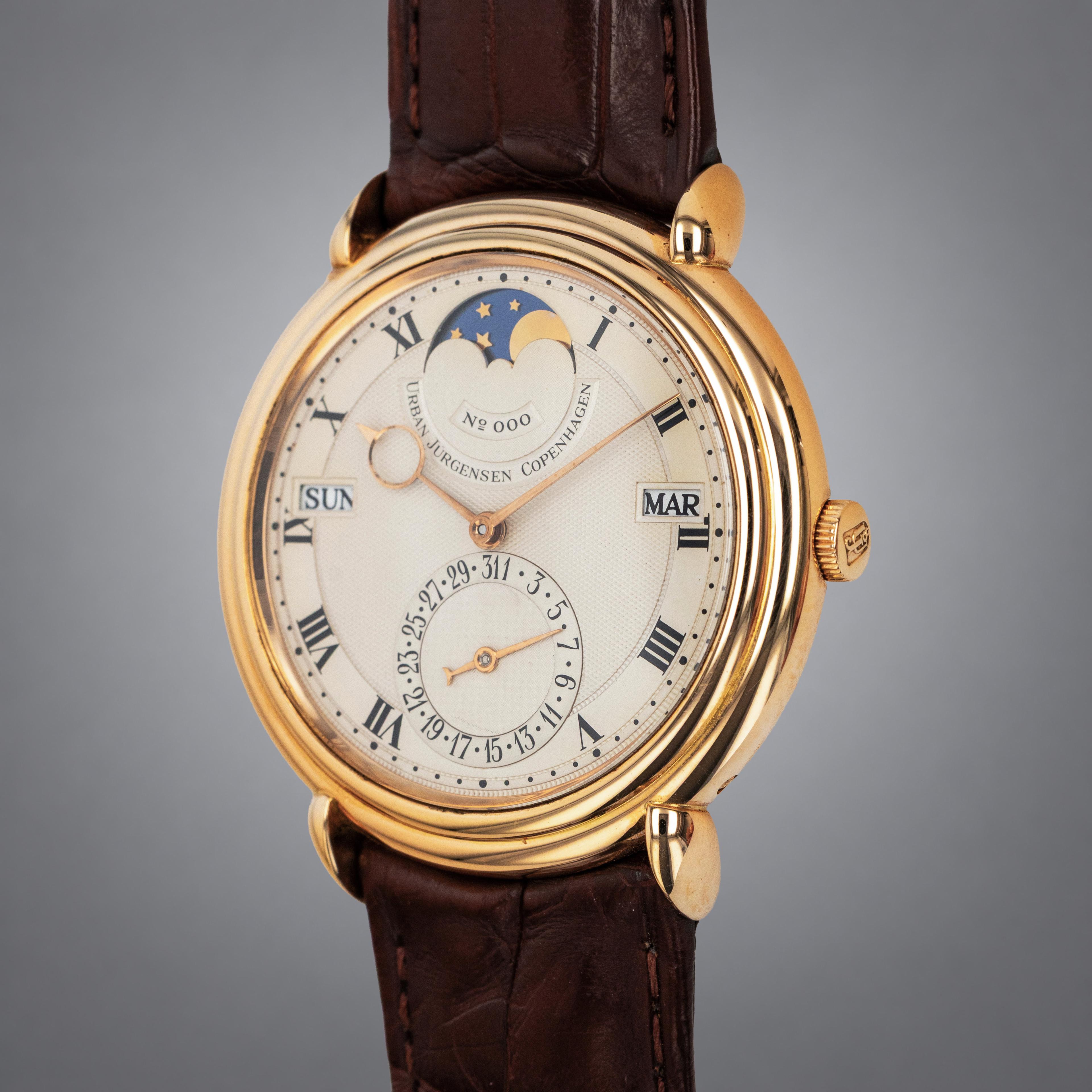
2; " No.000", Perpetual Calendar, Moonphase, Guilloché Dial, Rose Gold (18-carat)
Estimate: $200,000 – 400,000
- Brand
- Urban Jürgensen
- Model
- Perpetual Calendar
- Year
- Circa 1996
- Reference
- 2
- Movement
- No. 000-000
- Calibre
- Frédéric Piguet 71, self-winding, 35 jewels
- Case
- No. 4266
- Materials
- Rose gold (18-carat)
- Bracelet
- Leather strap
- Buckle
- rose gold (18-carat) UJ pin-buckle
- Dimensions
- 38 mm
- Thickness
- 10 mm
- Signature
- Dial, case and movement
- Accessories
- Box, additional case-back, Certificate of Origin card, glove, and service papers
The Urban Jürgensen Reference 2 Perpetual Calendar represents a significant achievement in independent watchmaking, combining the classical design language of the historic Danish manufacture with the mechanical sophistication of Swiss haute horlogerie. Introduced in 1986 under the stewardship of Peter Baumberger, with the technical contributions of master watchmaker Derek Pratt, the Reference 2 exemplifies the revival of traditional handcraftsmanship during the renaissance of mechanical watchmaking. Its 38 mm case is crafted in 18-carat pink gold, featuring the signature stepped bezel, concave caseband and individually hand-soldered teardrop lugs, hallmarks of Urban Jürgensen’s distinctive case architecture. The solid silver dial showcases an exquisite arrangement of hand-turned guilloché, combining a central grain d’orge pattern with a finely brushed Roman numeral chapter ring and basketweave-patterned calendar subdials. A blue enamel moonphase display at 12 o’clock provides a striking contrast, complemented by the manufacture’s distinctive gold hoop hour hand and gold calendar hands. Powering the watch is the automatic calibre Frédéric Piguet 71, integrated with a Lémania perpetual calendar module. The movement features an offset 21-carat yellow gold rotor decorated with engine-turned guilloché, complemented by Côtes de Genève, hand-bevelled edges and polished countersinks. Distinguished by its intricate calendar complication, exceptional dial artistry and purported prototype status, this Urban Jürgensen Reference 2 offers a compelling representation of the independent watchmaking renaissance of the late twentieth century. ––
Biography
Urban Bruun Jürgensen (1776–1830) Urban Bruun Jürgensen was a distinguished Danish master watchmaker, chronometrist and horological author whose contributions to precision timekeeping established Denmark as an important centre of scientific watchmaking in the early nineteenth century. Born in Copenhagen on 5 August 1776, he was the son of royal watchmaker Jürgen Jürgensen, who founded the family’s watchmaking dynasty in 1773. After receiving his initial training in his father’s workshop, Urban Bruun Jürgensen travelled extensively throughout Europe, studying under some of the greatest horological minds of his era, including Abraham-Louis Breguet in Paris, John Arnold in England and Jacques-Frédéric Houriet in Switzerland. These formative experiences shaped his rigorous approach to mechanical precision and technical innovation. In 1804, he published Regler for Tidens nøjagtige Afmaaling ved Uhre (Rules for the Accurate Measurement of Time), a landmark treatise that became an influential reference for generations of watchmakers. He subsequently devoted himself to the development of precision marine chronometers, beginning production in 1810 for applications including Danish naval navigation. His technical achievements included advances in escapement design and chronometric accuracy, contributing significantly to the evolution of precision timekeeping. His accomplishments earned him considerable recognition. In 1815, he became the first watchmaker admitted to the Royal Danish Academy of Sciences and Letters, and in 1824, he was appointed a Knight of the Order of the Dannebrog. Before his death on 14 May 1830, he had produced an important body of precision instruments and fine timepieces. Urban Bruun Jürgensen’s legacy continued through his sons, Louis Urban and Jules Frederik, who carried the family’s horological traditions forward in Denmark and Switzerland. Today, his name remains synonymous with scientific rigour, artisanal excellence and the enduring heritage of independent European watchmaking.