
 1 / 11
14 Nov 2026
75 / Patek Philippe
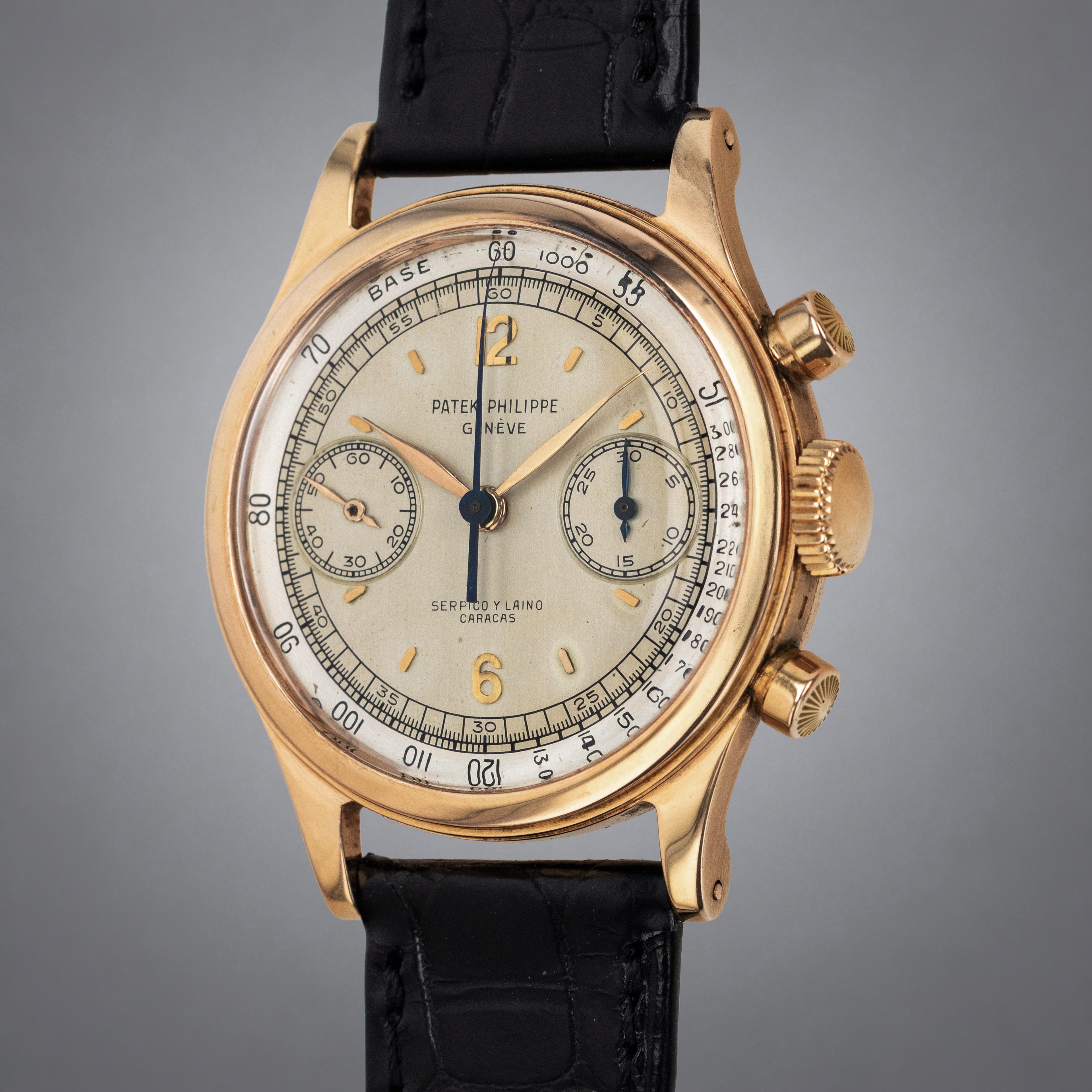
1463R, Rare Two-Tone, “Serpico Y Laino”, Chronograph, “Tasti Tondi”, Rose Gold (18-Carat)
Estimate: $300,000 – 600,000
- Brand
- Patek Philippe, Geneva
- Model
- "Tasti Tondi" Chronograph
- Retailed by
- Serpico y Laino, Caracas (Venezuela)
- Year
- Circa 1950
- Reference
- 1463 R
- Movement
- 867984
- Calibre
- 13-130, manual-winding, 23 Jewels
- Case
- No. 657140
- Materials
- Rose gold (18-carat)
- Bracelet
- Rose gold (18-carat)
- Dimensions
- Ø 35 mm (approx.)
- Thickness
- 12 mm (approx.)
- Signature
- Dial, case and movement
- Accessories
- Extract from the Archives
Patek Philippe Reference 1463 "Tasti Tondi" Retailed by Serpico y Laino, Caracas The Patek Philippe Reference 1463 is one of the most celebrated vintage chronographs, distinguished as the manufacture’s first series-produced water-resistant chronograph. Introduced in 1940, it is instantly recognizable by its sculpted 35mm case and signature round fluted chronograph pushers, affectionately known as “Tasti Tondi” among collectors. Crafted in (18-carat) rose gold, the present lot is further distinguished by its double-signed dial bearing the prestigious “Serpico y Laino Caracas” retailer signature. One of Patek Philippe’s notable South American retail partners, Serpico y Laino supplied fine timepieces to discerning collectors, making its signature a particularly appealing feature of vintage examples. The two-tone dial, manufactured by Stern Frères, features applied pink gold Arabic numerals, faceted baton markers, a railway minute track and an outer tachymeter scale. Its balanced subsidiary registers display running seconds and elapsed chronograph minutes, reflecting the functional elegance of mid-century watchmaking. The watch is powered by the manual-winding Patek Philippe Calibre 13'''-130, based on the Valjoux 23 architecture and refined with a traditional column-wheel chronograph mechanism. Featuring 23 jewels and finely decorated bridges with Côtes de Genève finishing, the movement exemplifies the manufacture’s commitment to precision and craftsmanship. Combining the rarity of pink gold, the distinctive Tasti Tondi case and the coveted Serpico y Laino signature, the present lot is an attractive addition to any collection of important vintage Patek Philippe chronographs. –– Serpico y Laino, Caracas Serpico y Laino is a jewellery business and watch retailer established in Caracas, Venezuela. It does not manufacture its own watches. Its place in the history of watchmaking rests on its relationships with Swiss manufacturers, its distribution of watches and other luxury goods, and the pieces bearing its name on the dial or its initials on the case. The date of its foundation remains uncertain. “Gli Italiani in Venezuela”, published in Caracas in 1931 by Ermenegildo Aliprandi and Virgilio Martini, describes Serpico & Laino as an already long-established firm, founded in 1906, and identifies Leopoldo Serpico and Vincenzo Laino as its proprietors. The book gives the shop’s address at Bolsa a Mercaderes, No. 19. A later account (Gallardo, 2013) dates the formation of the partnership between Serpico and Laino to 1925. These dates may refer to different stages in the firm’s history, but the available sources do not confirm this. Three detailed accounts provide the earliest identified testimony on the firm’s history: posts by “Viela”, the pseudonym of a participant in the “Relojes Especiales” forum, published in September 2008; Luciano Buscarini’s article “Flash, Serpico y Laino. Vicente Laino”, published in “Rolex Passion Report” on 18 April 2009 (pp. 18–21); and a post by Williams Gallardo, published on his “Serpico & Laino” blog on 6 March 2013. Gallardo describes himself as Venezuelan, an enthusiast of vintage watches and an automotive restorer. He thanks Buscarini and Laura Tedeschi, and explicitly refers to “Viela’s” testimony. Several later accounts draw on material from these texts. “Viela” offers personal recollections and reports statements attributed to Agustín Laino; his account nevertheless remains a forum post rather than an archival document. Leopoldo Serpico runs a jewellery shop in Caracas, the “Joyería Serpico”, where jewellery is sold and repaired. Vicente – or Vincenzo – Laino, who comes from Rivello in Basilicata, Italy, is a goldsmith. According to Buscarini and Gallardo, Serpico invites him to join the business as a “socio industrial”: Laino contributes his skills, ideas and commercial ability rather than financial capital. The sources consulted do not give the birth dates of either founder. They place Serpico’s death in 1944 and Laino’s in 1959, but do not specify the circumstances of Serpico’s death. In the early 1930s, Laino travels to Geneva in search of watches likely to find a market in Venezuela. According to Buscarini, he chooses Rolex, then returns to Europe to negotiate the terms of the brand’s distribution and meets Hans Wilsdorf (1881–1960). Contemporary advertisements also identify Serpico y Laino as the exclusive agent for Patek Philippe and Ebel. The firm also sells jewellery, silverware and other luxury goods. The relationship between the two partners also becomes a family one. Laino falls in love with the sister of Serpico’s wife. While the couple are preparing to marry, the Italian government calls Laino up for military service at the beginning of the Second World War. He leaves Venezuela to join the Italian army. Later accounts state that he marries her, but do not give the date. His wife dies prematurely, leaving him with two children. Serpico dies in 1944, while Laino is still in Europe. After the war, Laino resumes the management of the firm and increases his business travel across the continent. During his absences, several relatives help run the business: Fernando Ponce de León, Leopoldo Serpico’s son-in-law; Agustín Laino, Vicente’s eldest son; Efraín Serpico, Leopoldo’s son; Domingo Laino, Vicente’s brother, who works in the shop but is not a partner; and Andréas Gambardella Laino, Vicente’s nephew. Rolex and Patek Philippe watches bearing the retailer’s signature testify to these commercial relationships. “Serpico y Laino” appears on some dials; the initials “S & L” are sometimes engraved on the case. Some watches bear both signatures. These marks appear on some of the watches sold by the firm, but not on its entire range. Laino dies in 1959. His successors continue the business and, that year, open the “Joyería Sucursal del Este” on Avenida Francisco de Miranda in Caracas. According to Buscarini and Gallardo, kidnapping attempts against members of both families and a bomb attack on this branch contribute to the closure of the original business in 1966. The 1966 closure does not necessarily mark the end of all commercial activity under the name Serpico y Laino. After the original business closes, Andréas Gambardella Laino reopens a shop in central Caracas. Gallardo reports that he initially trades under the name “Serla”, then resumes the Serpico y Laino name with the families’ permission. “Viela” likewise states that a relative reopens the jewellery shop in the same premises under the historic name, but without Rolex exclusivity. He describes the shop and reports that Agustín Laino told him that the business had moved from its original address, No. 19, to No. 21, probably in the late 1930s or early 1940s. “Viela” presents this dating as uncertain. According to Buscarini and Gallardo, Gambardella Laino dies in the early 1970s. His widow moves to Italy with their four children, while a manager subsequently attempts to maintain or revive the business. “Viela”, who says he visited the shop and remembers its layout, places its final closure in 1991. Joyería Roca Hnos. states that Serpico y Laino ceased operations in the 1970s. It adds that Serpico y Laino appointed Roca to represent Rolex and Patek Philippe (in 1953?), a role Roca retained until the former ceased trading. These accounts may refer to different stages: the end of the original firm’s commercial representation, followed by the closure of the shop taken over by Gambardella Laino. The 1991 date rests on “Viela’s” testimony, reproduced by Gallardo, and has not been independently confirmed by commercial records. The firm’s history unfolds in a Venezuela whose public revenues and economic activity depend to a large extent on oil. European immigration, particularly from Italy, also assumes considerable importance in the country during the mid-twentieth century. This context helps explain the growth of a major retailer specialising in imported luxury goods, but provides no direct evidence about its clientele or commercial performance. A business bearing the name Serpico y Laino is now established in Key Biscayne, Florida. Its arrival in the town was announced in 2019; the Florida company currently registered under that name was incorporated in 2015. The available sources do not demonstrate legal continuity with the historic Caracas firm. Serpico y Laino is thus a luxury retailer whose history unfolds in several stages: the early activity of the Serpico business, its partnership with Vicente Laino, the development of its watch distribution, its closure in 1966, and the subsequent reopening of the shop by a family member. The double-signed watches preserve evidence of its relationships with Swiss manufacturers. The date of foundation remains to be established, and the birth dates of the founders and their relatives remain unknown in the sources consulted. On the available testimony, the closure of the original firm in 1966 and that of the shop in 1991 mark two distinct moments in its history. ––
Biography
Patek Philippe, Master of all Horological Complication Patek Philippe is a prestigious Swiss watch manufacturer, renowned for its luxury watches and exceptional craftsmanship. Founded in 1839 in Geneva by Antoine Norbert de Patek (1812-1877) and François Czapek (1811-after 1869), the company quickly established its reputation as a manufacturer of superior watches. In 1844, following the National Exhibition of French Industrial Products in Paris, Antoine Norbert de Patek met Jean-Adrien Philippe (1814-1894), a young French watchmaker. In 1845, after Czapek’s departure, the two men concluded a commercial agreement and introduced numerous innovations in the field of watchmaking, notably a keyless-winding and time-setting system for which Philippe received a Bronze medal. In 1851, the company was renamed “Patek, Philippe & Cie – Fabricants à Genève”, and over the decades became synonymous with exclusivity, precision and technical perfection as evidenced by the wristwatch made for the countess Hungarian Koscowicz (1868), patents for a precision regulator (1881), a perpetual calendar mechanism (1889), a double chronograph (1902) and all the brand’s creations, whether pocket watches or watches. bracelets with horological complications. From the early 1900s until 1927, Patek Philippe introduced a unique business model. The house’s main distributor based in Rio de Janeiro in Brazil, “Gondolo & Labouriau” sold more than a third of the production at the time thanks to a cleverly orchestrated sales system. These timepieces, known as “Chronometro Gondolo”, are collector’s items famous both for their very high technical quality and for their unique history. The watches were sold at the time, exclusively to members of a very select clubs called the “Gondolo Gang” which have 180 members. Being part of these collector’s clubs was, at the beginning of the 20th century, a distinctive sign of success in Brazilian society. According to an ingenious raffle system, each member of the club agrees to buy a watch for the amount of 790 Swiss francs divided into 79 weekly instalments of 10 francs. During these 79 weeks of repayment, a weekly draw is organized where the winner is released from the balance of his debt. The first winner pays 10 francs for their watch, the second 20 francs, etc. The earlier you buy your watch, the cheaper it costs, provided you win this lottery. Echoing this episode in its history, the “Gondolo” collection was reinterpreted in 1993 with shaped watches. In 1932, Patek Philippe became a family business when the Stern family, already involved in the production of dials for the brand, bought the company. It is also the year of the launch of a model that will become the brand’s flagship collection: the “Calatrava”. Even today, it contributes to the success and reputation of the company. Among the emblematic models of Patek Philippe, we can also mention the “Ellipse” (1968) with its elliptical-shaped case, at the crossroads of the circle and the rectangle which is inspired by the “golden ratio”; the “Nautilus” (1976), a sporty and luxurious watch whose case is inspired by a porthole; or watches for women, such as the “Twenty-4” collection (1999), which combines feminine elegance with horological precision. Since its creation, the brand has been driven by a spirit of innovation. In 1989, Patek Philippe released a very complex model to celebrate its 150th anniversary. Named “Calibre 89”, the watch is equipped with 33 horological complications and its calibre is made up of 1 728 parts. Eleven years later, in order to celebrate the second millennium, the brand released the “Star Calibre 2000” model, a double-sided pocket watch with 21 horological complications. Finally, the year 2002 saw the launch of the “Sky Moon Tourbillon” model, the most complicated double-sided wristwatch ever produced by the house. Benchmark precision instruments, Patek Philippe watches are also recognized by collectors for being objects of art whose beauty reflects perfection. For many years, Patek Philippe has strived to preserve all the high craftsmanship professions linked for more than four centuries to the decoration of timepieces. This is how exceptional contemporary creations come into being – pocket watches, wristwatches, or clocks –, most often unique pieces, which highlight all these skills that are threatened with disappearance. This transmission value is essential for the brand. Patek Philippe can be proud of having filed more than 70 patents since its creation, notably for a Gyromax balance-wheel (1949), mechanical watches with time zones (1959), a mechanical movement with peripheral rotor (1964), an indicator mechanism of the date of Easter (1985), an annual calendar (1996) or even an astronomical representation mechanism (2000). These technical innovations have largely contributed to advancing the horological industry while contributing to the brand’s reputation for excellence. Today, Patek Philippe is a watch brand that continues to produce superior quality watches that are admired by watch enthusiasts around the world. -- Key Dates • 1839: foundation of “Patek, Czapek & Cie2 by Antoine Norbert de Patek and François Czapek in Geneva. • 1845: following the departure of Czapek, the company becomes “Patek & Cie”. Arrival of Jean-Adrien Philippe, a young French watchmaker who invented a keyless-winding and time-setting mechanism. • 1851: the company is now called “Patek, Philippe & Cie”. The house presented its products at the Universal Exhibition in London, the first event of its kind. • 1868: manufacture of the first wristwatch for the Hungarian Countess Koscowicz. • 1901: the company becomes a public limited company. • 1932: acquisition of a majority of shares by the Stern family, one of the manufacturers of dials for the brand. Launch of the reference 96 which will later be called “Calatrava”. • 1949: patent for the “Gyromax” balance-wheel. • 1953: launch of the self-winding “Calibre 12-600 AT”. • 1968: launch of the first “Golden Ellipse” model, the Ref. 3548. • 1976: launch of the first “Nautilus” sports watch, the Ref. 3700/1 in stainless steel. • 1989: 150th anniversary of the manufacture. Launch of various commemorative watches and the “Calibre 89”, at the time the most complicated watch ever made, with 33 horological complications. • 1996: establishment of the new factory in Plan-les-Ouates, near Geneva. • 2001: inauguration of the Patek Philippe Museum in Geneva, exhibiting a remarkable collection of antique watches, horological art and enamel (1500-1850), and Patek Philippe watches. • 2019: 180th anniversary of the manufacture. -- Iconic models and current collections • “Calatrava”: this collection is emblematic of the manufacture. These watches are distinguished by their clean and classic design, with a round case and a minimalist dial. The “Calatrava” embodies timeless elegance and represents the brand’s traditional watchmaking know-how. • “Nautilus”: this model is one of the most emblematic models of the manufacture. Designed by Gérald Genta, it is high-end sports watch recognizable by its octagonal case and its integrated bracelet. It offers a perfect balance between sportiness and elegance. • “Aquanaut”: this collection is another line of sports watches from Patek Philippe. These watches are characterized by its octagonal case and rubber strap. It offers a contemporary aesthetic and high resistance to hydrostatic pressure. • “Twenty-4”: this collection is specially designed for women. These watches combine classic elegance with contemporary style. Initially equipped with a rectangular-shaped case and offering a selection of models with diamonds and steel or gold bracelets, they are now round in shape.