
 1 / 7
14 Nov 2026
76 / Patek Philippe
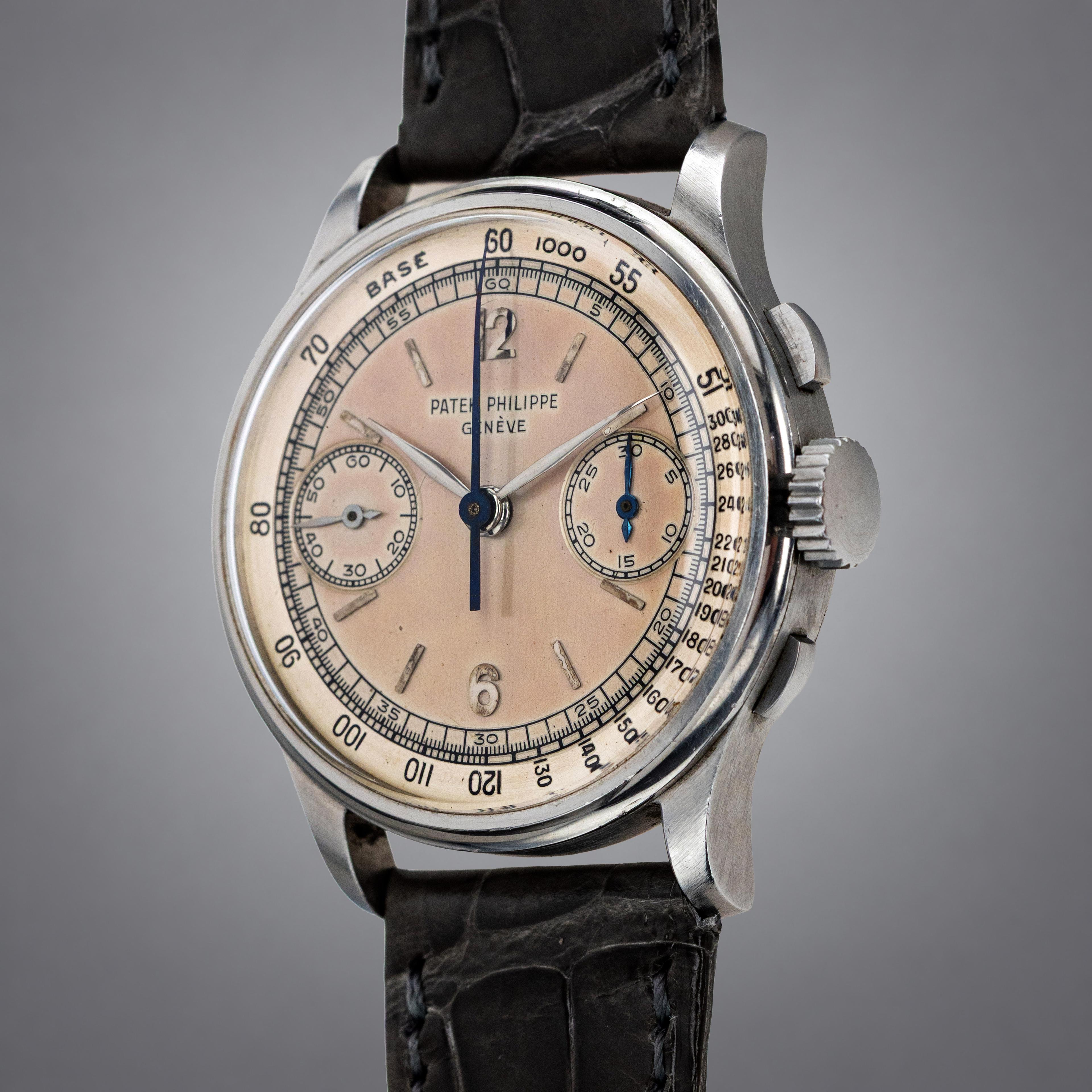
130A, "Full Set", Two-Tone, Chronograph, Minute Counter, Tachometer Scale, Stainless Steel
Estimate: $200,000 – 400,000
- Brand
- Patek Philippe, Geneva
- Year
- Circa 1949
- Reference
- 130A
- Movement
- No. 867 675
- Calibre
- 13-130 CC, manual-winding, 23 jewels
- Case
- No. 653 979
- Material
- Stainless steel
- Bracelet
- Leather strap
- Buckle
- stainless steel pin-buckle
- Dimensions
- Ø 34 mm (approx.)
- Thickness
- 12.5 mm (approx.)
- Signature
- dial, case and movement
- Accessories
- original fitted box, Certificate of Origin (dated May 17, 1950), servicing invoice (dated October 10, 1957); and Extract from the Archives
- •
- 1/5 second chronograph with tachometer scale graduated on the dial for 1 000 units per hour
- •
- Half-instantaneous 30-minute counter (subsidiary dial at 3 o’clock)
Patek Philippe, Reference 130 Reference 130 is launched in 1934 and remained in production until circa 1964. This round-shaped watch (Ø 33 mm.) is fitted with a 13’’’ round-shaped movement, the manual-winding Cal. 13-130 CC, with chronograph and 30-minute counter. The majority in yellow gold, more rarely in pink gold, even more rarely in stainless steel of some examples have a gold bezel. The three-piece case, snap-on case-back, was made by Emile Vichet, Geneva (master hallmark number 9; this number inside the Key of Geneva). Stainless steel case were made by three case-makers: Edouard Wenger, Geneva (master hallmark number 1; this number inside the Key of Geneva). Georges Croisier, Geneva (master hallmark number 5; this number inside the Key of Geneva). Charles Dubois & Cie, Le Locle (master hallmark number 170; this number inside the hammer head of the Neuchâtel mountains). The dial was made by Stern Frères, Geneva. Depending on the period in which the dials were produced, there are dials with “long” and “short” signatures. The 1948 date is generally accepted as the date of change. Around 1 500 pieces were produced. Production can be divided as follows: Yellow gold (Ref. 130 J), approximately 850 pieces, of which around 355 appeared on the art market Pink gold (Ref. 130 R), approximately 360 pieces, of which around 130 appeared on the art market Stainless steel (Ref. 130 A), approximately 270 pieces, of which around 105 appeared on the art market Other, approximately 10 pieces, of which around 3 appeared on the art market. The calibre 13-130 CC (the first C for chronograph, the second C for counter) is based on a Valjoux ébauche (Ø 29.5 mm.) which has been used by Patek Philippe since 1936 for all its chronograph wristwatches. This blank (ébauche in French) is finished by the master watchmakers of the Genevan manufacture to a very high quality of craftsmanship that has no real competition in terms of quality on the market. During the many years of life of this movement, a few notable changes should be mentioned: As early as 1944, the addition of a fine adjustment of the regulating racket thanks to a micrometric regulator (which is not necessarily fitted to all movements); From 1946, the new non-magnetic balance (it should be noted here that many bimetallic compensated balances were replaced during after-sales service at the Manufacture over the years, as late as the 1980s!). Some movements are stamped with the Geneva Seal, in no logical sequence. In fact, depending on the market for which the watch was destined, this finishing was either carried out or not, in the knowledge that the cost price, and therefore the selling price, would be affected. A wide range of dials are available: With Roman numerals (VI-XII) or Arabic numerals (6-12) and indexes that can be thin or wide, short or long. With ‘Breguet’ Arabic numerals (without the 3 and 9), known as the “Heures Penchées” (HP); these dials were mainly made for the American market. With lapidated indexes, known as “Heures Lapidées” (HL). Luminous dots (phosphorescent material such as Tritium) may have been added to older models (they can also be found on the very latest models). There are a few dials with black backgrounds, in “Duco” lacquer (they are the most coveted by collectors; the black dial with ‘Breguet’ numerals is a must). Naturally, depending on the year of production, these dials bear either the ‘long’ or the ‘short’ signature. The 1948 date seems to be the one that bears this change, but it is obvious that dials with the short signature that remained in stock may have been put on new pieces, just as damaged dials may have been replaced by new ones. Other dials exist, but they are the exception rather than the rule, and most of them are unique. We would like to thank Eric and Gabriel Tortella, The Watch and Market Observers S.A., Geneva, for some of the information provided in this note. -- What is a chronograph? A chronograph is a horological mechanism that measures intervals of time with precision. Unlike an ordinary watch that simply indicates the time, a chronograph has additional functions that allow a time counter to be started, stopped and reset independently of the time indication. These functions are generally activated by push-pieces located on the outside of the watch case. Chronographs are often used in contexts where the precise measurement of time is important, such as sport, aviation, or even simply as a practical extra function in an everyday watch. It is now accepted that Louis Moinet (1768-1853) made a first version in 1816, followed in 1821 by Nicolas-Mathieu Rieussec (1781-1866), who gave it the name we use today. The chronograph in its current form was developed in the early 1880s. From the early 1930s onwards (c.1933), Patek Philippe began manufacturing in series wristwatches with chronographs and minute counters; initially, around fifty pieces were produced each year, later increasing to around one hundred. --
Biography
Patek Philippe, Master of all Horological Complication Patek Philippe is a prestigious Swiss watch manufacturer, renowned for its luxury watches and exceptional craftsmanship. Founded in 1839 in Geneva by Antoine Norbert de Patek (1812-1877) and François Czapek (1811-after 1869), the company quickly established its reputation as a manufacturer of superior watches. In 1844, following the National Exhibition of French Industrial Products in Paris, Antoine Norbert de Patek met Jean-Adrien Philippe (1814-1894), a young French watchmaker. In 1845, after Czapek’s departure, the two men concluded a commercial agreement and introduced numerous innovations in the field of watchmaking, notably a keyless-winding and time-setting system for which Philippe received a Bronze medal. In 1851, the company was renamed “Patek, Philippe & Cie – Fabricants à Genève”, and over the decades became synonymous with exclusivity, precision and technical perfection as evidenced by the wristwatch made for the countess Hungarian Koscowicz (1868), patents for a precision regulator (1881), a perpetual calendar mechanism (1889), a double chronograph (1902) and all the brand’s creations, whether pocket watches or watches. bracelets with horological complications. From the early 1900s until 1927, Patek Philippe introduced a unique business model. The house’s main distributor based in Rio de Janeiro in Brazil, “Gondolo & Labouriau” sold more than a third of the production at the time thanks to a cleverly orchestrated sales system. These timepieces, known as “Chronometro Gondolo”, are collector’s items famous both for their very high technical quality and for their unique history. The watches were sold at the time, exclusively to members of a very select clubs called the “Gondolo Gang” which have 180 members. Being part of these collector’s clubs was, at the beginning of the 20th century, a distinctive sign of success in Brazilian society. According to an ingenious raffle system, each member of the club agrees to buy a watch for the amount of 790 Swiss francs divided into 79 weekly instalments of 10 francs. During these 79 weeks of repayment, a weekly draw is organized where the winner is released from the balance of his debt. The first winner pays 10 francs for their watch, the second 20 francs, etc. The earlier you buy your watch, the cheaper it costs, provided you win this lottery. Echoing this episode in its history, the “Gondolo” collection was reinterpreted in 1993 with shaped watches. In 1932, Patek Philippe became a family business when the Stern family, already involved in the production of dials for the brand, bought the company. It is also the year of the launch of a model that will become the brand’s flagship collection: the “Calatrava”. Even today, it contributes to the success and reputation of the company. Among the emblematic models of Patek Philippe, we can also mention the “Ellipse” (1968) with its elliptical-shaped case, at the crossroads of the circle and the rectangle which is inspired by the “golden ratio”; the “Nautilus” (1976), a sporty and luxurious watch whose case is inspired by a porthole; or watches for women, such as the “Twenty-4” collection (1999), which combines feminine elegance with horological precision. Since its creation, the brand has been driven by a spirit of innovation. In 1989, Patek Philippe released a very complex model to celebrate its 150th anniversary. Named “Calibre 89”, the watch is equipped with 33 horological complications and its calibre is made up of 1 728 parts. Eleven years later, in order to celebrate the second millennium, the brand released the “Star Calibre 2000” model, a double-sided pocket watch with 21 horological complications. Finally, the year 2002 saw the launch of the “Sky Moon Tourbillon” model, the most complicated double-sided wristwatch ever produced by the house. Benchmark precision instruments, Patek Philippe watches are also recognized by collectors for being objects of art whose beauty reflects perfection. For many years, Patek Philippe has strived to preserve all the high craftsmanship professions linked for more than four centuries to the decoration of timepieces. This is how exceptional contemporary creations come into being – pocket watches, wristwatches, or clocks –, most often unique pieces, which highlight all these skills that are threatened with disappearance. This transmission value is essential for the brand. Patek Philippe can be proud of having filed more than 70 patents since its creation, notably for a Gyromax balance-wheel (1949), mechanical watches with time zones (1959), a mechanical movement with peripheral rotor (1964), an indicator mechanism of the date of Easter (1985), an annual calendar (1996) or even an astronomical representation mechanism (2000). These technical innovations have largely contributed to advancing the horological industry while contributing to the brand’s reputation for excellence. Today, Patek Philippe is a watch brand that continues to produce superior quality watches that are admired by watch enthusiasts around the world. -- Key Dates • 1839: foundation of “Patek, Czapek & Cie2 by Antoine Norbert de Patek and François Czapek in Geneva. • 1845: following the departure of Czapek, the company becomes “Patek & Cie”. Arrival of Jean-Adrien Philippe, a young French watchmaker who invented a keyless-winding and time-setting mechanism. • 1851: the company is now called “Patek, Philippe & Cie”. The house presented its products at the Universal Exhibition in London, the first event of its kind. • 1868: manufacture of the first wristwatch for the Hungarian Countess Koscowicz. • 1901: the company becomes a public limited company. • 1932: acquisition of a majority of shares by the Stern family, one of the manufacturers of dials for the brand. Launch of the reference 96 which will later be called “Calatrava”. • 1949: patent for the “Gyromax” balance-wheel. • 1953: launch of the self-winding “Calibre 12-600 AT”. • 1968: launch of the first “Golden Ellipse” model, the Ref. 3548. • 1976: launch of the first “Nautilus” sports watch, the Ref. 3700/1 in stainless steel. • 1989: 150th anniversary of the manufacture. Launch of various commemorative watches and the “Calibre 89”, at the time the most complicated watch ever made, with 33 horological complications. • 1996: establishment of the new factory in Plan-les-Ouates, near Geneva. • 2001: inauguration of the Patek Philippe Museum in Geneva, exhibiting a remarkable collection of antique watches, horological art and enamel (1500-1850), and Patek Philippe watches. • 2019: 180th anniversary of the manufacture. -- Iconic models and current collections • “Calatrava”: this collection is emblematic of the manufacture. These watches are distinguished by their clean and classic design, with a round case and a minimalist dial. The “Calatrava” embodies timeless elegance and represents the brand’s traditional watchmaking know-how. • “Nautilus”: this model is one of the most emblematic models of the manufacture. Designed by Gérald Genta, it is high-end sports watch recognizable by its octagonal case and its integrated bracelet. It offers a perfect balance between sportiness and elegance. • “Aquanaut”: this collection is another line of sports watches from Patek Philippe. These watches are characterized by its octagonal case and rubber strap. It offers a contemporary aesthetic and high resistance to hydrostatic pressure. • “Twenty-4”: this collection is specially designed for women. These watches combine classic elegance with contemporary style. Initially equipped with a rectangular-shaped case and offering a selection of models with diamonds and steel or gold bracelets, they are now round in shape. --