
 1 / 7
14 Nov 2026
8 / IWC
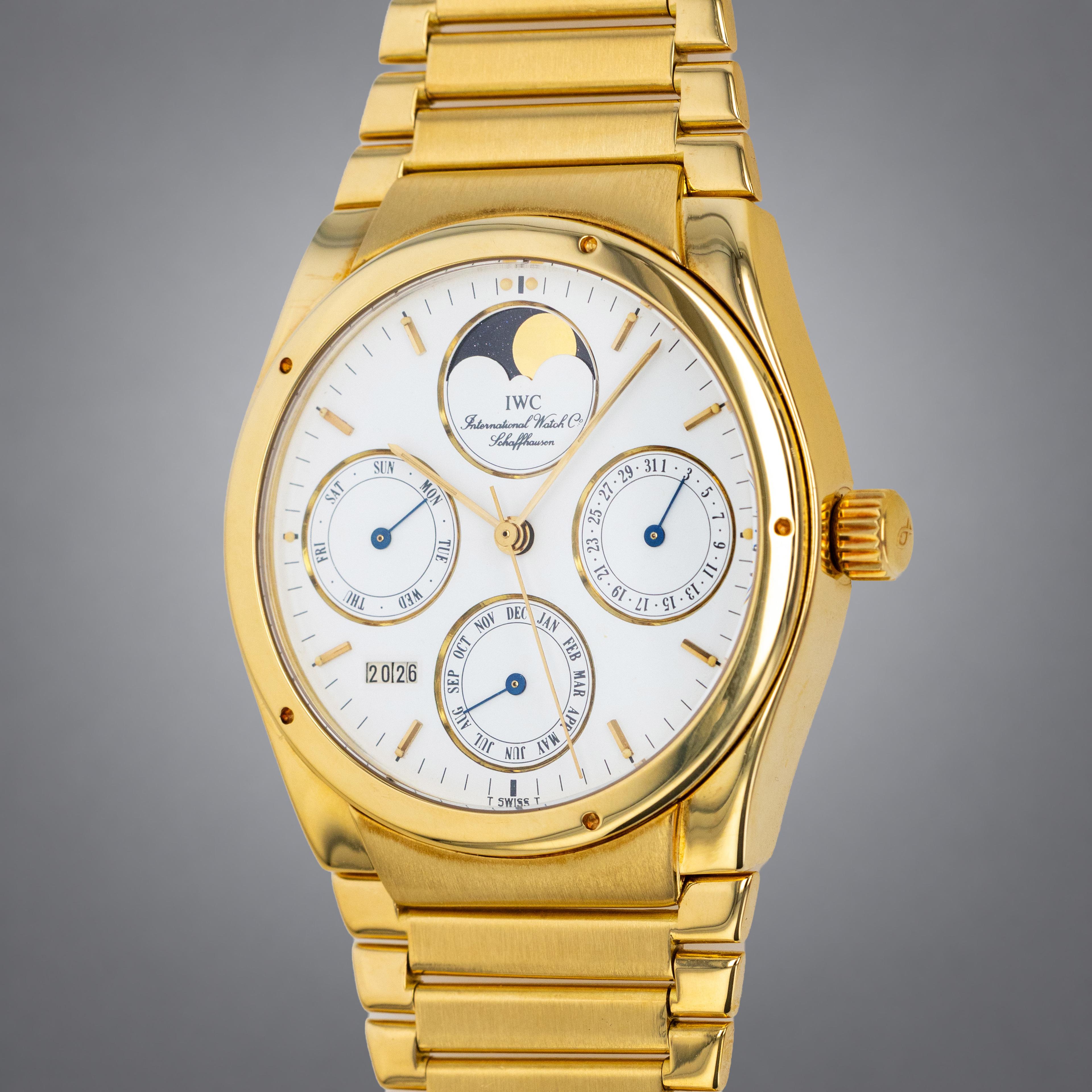
9240, Ingenieur, Perpetual Calendar, Self-Winding, Yellow Gold (18-carat)
Estimate: $20,000 – 26,000
- Brand
- IWC – International Watch Company
- Model
- Ingenieur Perpetual Calendar
- Year
- Circa 1985
- Reference
- 9240
- Movement
- No. 2407331
- Calibre
- 3757, Self-winding, 36 Jewels
- Case
- No. 2374459
- Materials
- Yellow gold (18-carat)
- Bracelet
- Integrated yellow gold (18-carat) bracelet with fold-over deployment buckle
- Dimensions
- Ø 36.5 mm
- Thickness
- 10 mm
- Length
- 199 mm (approx.)
- Weight
- 126.86 gr (approx.)
- Signature
- Dial, case and movement
The IWC Ingenieur Perpetual Calendar SL Ref. 9240 in Yellow Gold (18-carat) The present IWC Ingenieur SL Reference 9240 brings together the iconic geometric design of Gérald Genta with the revolutionary perpetual calendar mechanism developed by master watchmaker Kurt Klaus. Produced in the mid-1980s, the watch features a substantial yellow gold (18-carat) tonneau-shaped case with the signature five-recess bezel and fully integrated H-link gold bracelet. The combination of satin-brushed surfaces and polished elements highlights its sculptural architecture, while the internal soft-iron cage provides the Ingenieur’s renowned anti-magnetic protection. The elegant porcelain white dial displays the complete perpetual calendar, including day, date, month, moonphase and the distinctive four digit digital year indication. The calendar is mechanically synchronised and can be advanced entirely through the crown, without individual corrector pushers, a defining innovation of Klaus’s ingenious system. Powered by the automatic IWC Calibre 3757, Reference 9240 represents a rare fusion of Genta’s landmark sports watch design and one of the most important mechanical calendar systems of the modern era. Its short production period in yellow gold (18-carat) further enhances its desirability among collectors of important neo-vintage IWC timepieces. --
Biography
International Watch Company, IWC, Ingenious Watch Craftsmanship International Watch Company, also known as IWC, is a famous Swiss watch manufacturer founded in 1868 by Florentine Ariosto Jones (1841-1916), an American watchmaker from Boston. Looking for new opportunities in the watch industry, he moved to Switzerland and founded his own factory in Schaffhausen, a renowned watchmaking city, by combining traditional Swiss watchmaking techniques and modern production methods learned in the United States. Its ambition is to produce superior quality pocket watches for the American market. In 1875, IWC already had 196 employees. The company quickly ran into financial difficulties and in 1880 Jones sold the majority of the company’s shares to the Schaffhausen machine builder Johannes Rauschenbach-Vogel (1815-1881). When the latter died in 1881, his son Johannes Rauschenbach-Schenk (1856-1905) took over the business. Established industrialist and member of a wealthy family involved in the textile industry, his ambition is to financially recover and develop the potential of the company acquired by his father. Under the leadership of the Rauschenbach family, IWC prospered and became a renowned watch brand with striking creations in technical innovations. In 1885, the company presented its first watches with a digital hour and minute display (under the patented Pallweber’s device). Two years later, the “Magic” (1887), a pocket watch housed in a convertible case into a “savonnette” (hunting-case) or “Lépine” (open-face) and equipped with a 24-hour display, was born. Johannes Rauschenbach-Schenk dies in 1905, the company remains in the hands of his descendants. Ernst-Jakob Homberger (1869-1955) takes over the management of IWC as delegate of the Rauschenbach heirs. The company is redoubling its efforts to stay at the forefront of innovation. In 1915, IWC produced its first two calibres exclusively reserved for wristwatches, the calibre 75 (without seconds) and the calibre 76 (with small seconds). However, following the economic crisis of 1929, Ernst-Jakob Homberger became sole owner of the brand in the 1930s. This period saw the birth of two watch collections which, even today, are considered true icons of the brand. Known for its iconic technical watches produced in the 1930s and 1940s, the brand launched models specially designed for pilots, with luminous dials and practical features for use in flight. The first “Flieger-Uhr” (pilot’s watch) was designed in 1936 for civil aviation. It is particularly robust and resists temperature variations between - 40 and + 40° C while being antimagnetic. IWC responds to a British government tender and offers a special watch for Royal Air Force (RAF) pilots. The manufacture of the “Mark 11” model began in 1948 and from November 1949, it was delivered to aircrew and other armed forces of the Commonwealth. The watch was used until 1981. Thanks to their instantly recognizable design, these watches remain very popular around the world even today. Since 1936, IWC has perpetuated the tradition of pilots’ watches with models offering manual or self-winding movements and functions such as the chronograph, time zone display, UTC function or even a high-performance anti-shock system patented by the brand in 2021. The second iconic model manufactured in the late 1930s was the “Portugieser” model launched in 1939 following an order placed by Portuguese merchants wanting a series of wristwatches equipped with the extremely precise calibre of pocket watches. IWC then used hunting-case pocket watch movements of calibre 74 and 98, thus creating a visibly larger and very flashy wristwatch whose success was immediate. The company focuses on producing high-quality watches, combining cutting-edge engineering with traditional watchmaking know-how. Many remarkable horological inventions and complications were developed. This includes self-winding movements, anti-magnetic wristwatches, diving watches, chronographs, perpetual calendars, and minute-repeaters. IWC has been closely linked to the sport of diving since the 1960s. The growing popularity of this sport prompted the manufacturer to launch the “Aquatimer” in 1967. This withstands a pressure of 20 bar and is equipped with a rotating bezel internal for displaying dive time. In 2009, IWC presented a completely redesigned “Aquatimer” collection. The dive watches feature an easy-to-use external rotating bezel with integrated sapphire crystal, the lower part of which is covered with a thick layer of Super-LumiNova® luminescent coating. Over the decades, IWC has continued to innovate and develop high-quality watches, while preserving its watchmaking heritage and expertise. In 1969, during the quartz crisis, IWC unveiled its first “Da Vinci” wristwatch equipped with a quartz movement with a “tonneau”-shaped case. The collection was relaunched in 1985, marking the brand’s return to mechanical watchmaking with round models and horological complications such as perpetual calendars, moon phases and chronographs. At the beginning of 2001, the brand joined Richemont Group, which brings together several renowned watch brands. Today, IWC is globally recognized for its elegant watches, horological complications and distinctive aesthetics. The brand offers a wide range of collections, from classic and timeless watches to sporty and technological models. -- Key dates • 1868: Florentine Ariosto Jones, an American watchmaker, founded the International Watch Company in Schaffhausen, Switzerland. Jones’ goal is to combine Swiss watchmaking know-how with American manufacturing techniques. • 1880-1881: the factory passes into the hands of the Rauschenbach family. • 1885: launch of the movement with the “Pallweber” patent, which displays the hours and minutes on rotating discs. • 1905: on the death of Johannes Rauschenbach, Ernst Jakob Homberger takes over the management of IWC as delegate of the Rauschenbach heirs. • 1936: launch of the first “Flieger-Uhr”, intended for airplane pilots. These watches stand out for their robustness, readability, and functionality. • 1939: launch of the “Portugieser” watch. This collection becomes emblematic of the brand and is characterized by its refined design and large dimensions. • 1948: manufacture of the “Mark 11” model for the British Royal Air Force (RAF). • 1967: creation of the first antimagnetic diving watch, the “Aquatimer”. It is designed to withstand extreme underwater conditions and remains a mainstay of the IWC collection to this day. • 1969: IWC’s first “Da Vinci” wristwatch with the first quartz movement with a “tonneau”-shaped case. • 1985: IWC returns to the round case for its “Da Vinci” collection, which it equips with horological complications. • 2001: IWC brand is taken over by Richemont Group, which provides financial support and global visibility to the brand. • 2005: creation of the “Big Pilot’s Watch”, a watch with an imposing design that references the brand’s historic aviator’s watches. This watch becomes one of IWC’s most iconic models. -- Iconic models and current collections • “Portugieser”: this collection is one of IWC’s most emblematic. These watches are characterized by their refined dials, large cases and horological complications. • “Pilot’s Watch”: these watches are inspired by aviator’s watches. They stand out for their readable dials, large crowns and pilot-specific features, such as chronograph functions, power-reserve indicators and GMT functions. • “Aquatimer”: this collection is dedicated to professional diving watches. These watches are designed to withstand extreme marine environments and offer features such as unidirectional rotating bezel, high resistance to hydrostatic pressure and excellent readability underwater. • “Portofino”: this collection embodies classic and relaxed elegance. These watches are characterized by their timeless design, their refined dials and their watchmaking complications, such as calendars with moon phases and retrograde seconds. • “Ingenieur”: this collection, both sporty and elegant, combines style and refined design. • “Da Vinci”: this collection offers elegant watches with round cases and refined dials. These watches often feature horological complications, such as perpetual calendars, moon phases and chronographs. --