
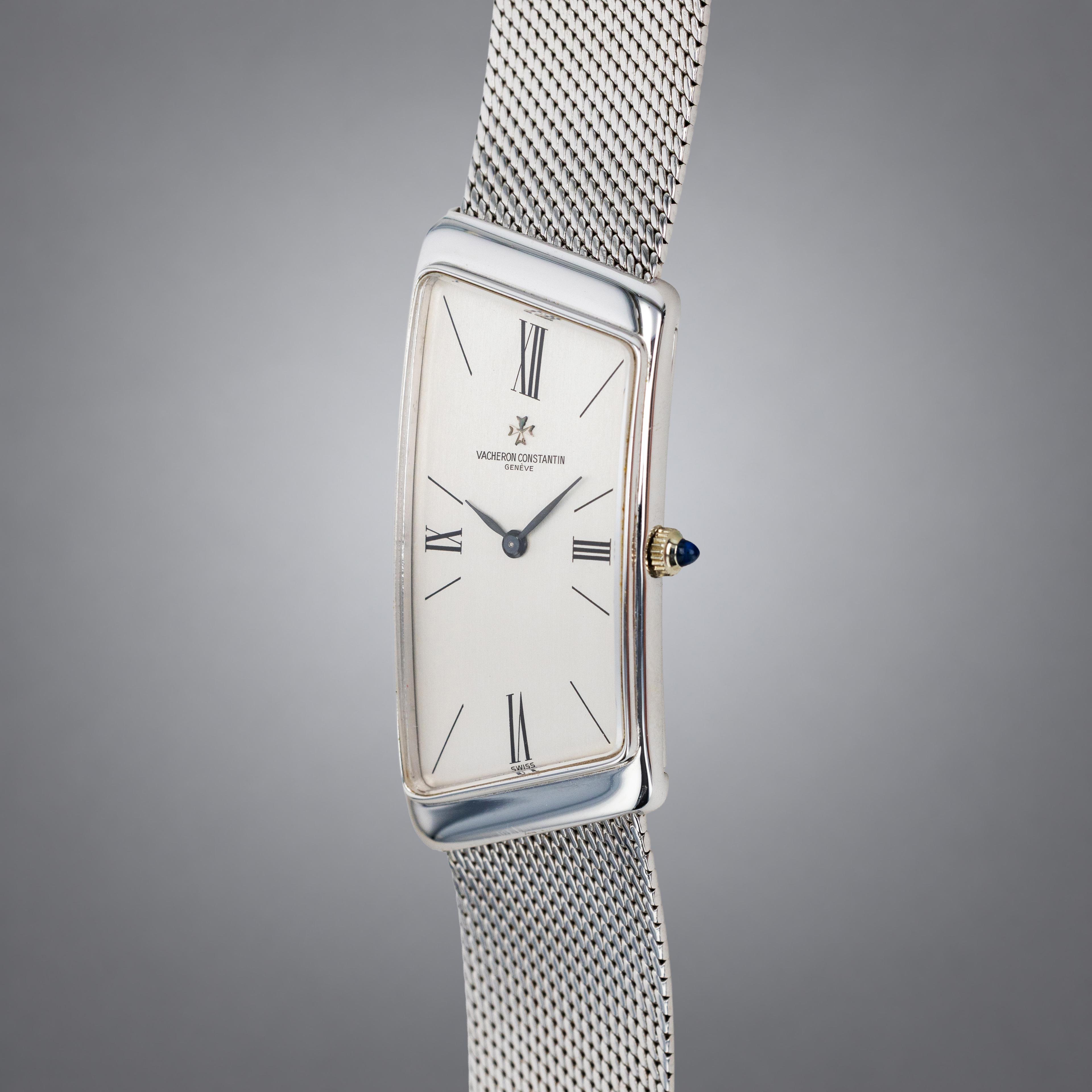
 1 / 9
14 Nov 2026
9 / Vacheron Constantin
35202, “Prestige de la France”; Manual-Winding, Silvered Dial; White Gold (18-Carat)
Estimate: $14,000 – 18,000
- Brand
- Vacheron Constantin, Geneva
- Model
- “Prestige de la France”
- Year
- Circa 1972
- Reference
- 35202
- Movement
- No. 625 390
- Calibre
- K1050/B, manual-winding
- Case
- No. 500 615
- Materials
- White gold (18-carat)
- Bracelet
- Integrated white gold (18-carat) woven mesh bracelet
- Buckle
- White gold (18-carat) integrated clasp with Maltese cross emblem
- Dimensions
- 46 x 21 mm
- Thickness
- 5.9 mm
- Length
- 184 mm (approx.)
- Weight
- 69.81 gr (approx.)
- Signature
- Dial, case and movement
The Vacheron Constantin “Prestige de la France” On 23 June 1972, in the reception rooms of the Hôtel Ritz in Paris, Vacheron Constantin received the Diplôme du Prestige de la France. The distinction was conferred by the Comité de Prestige et de Propagande Nationale in recognition of the manufacture’s expertise. Vacheron Constantin was the first watchmaking manufacture to be so honoured. To mark the occasion, the manufacture’s Paris design team conceived a wristwatch quite unlike anything else in its catalogue. Its elongated case was trapezoid-shaped and deliberately asymmetrical, gently curved to follow the wrist. The case-back of each example was engraved with the emblem of the Prestige de la France. The watch was produced in an extremely limited series. The large model, reference 35202, measures 46 by 21 mm. It houses the calibre 1050, a slim manual-winding movement with 20 jewels, chosen to keep the curved case as thin as possible. The model was offered in yellow and white gold with a range of dial colours. It was fitted either to a strap or to an integrated gold bracelet. The present example combines a white gold case with a brushed silvered dial bearing an applied Maltese cross and black Roman numerals. It is completed by a supple white gold mesh bracelet whose clasp carries the Maltese cross. The design never truly left the collection. Its proportions varied over the decades, and it was later renamed “1972” after the year of its creation. In 2013 Vacheron Constantin revisited the model for the opening of its first Paris boutique, at 2 Rue de la Paix. That edition, the “1972 Prestige”, was fitted with calibre 1003 and included a version limited to 40 pieces. The original 1970s examples, however, remain the purest expression of one of the manufacture’s most daring designs. ––
Biography
Vacheron Constantin, Nearly 270 Years of Excellence Vacheron Constantin is a historic Swiss watch manufacturer, founded in 1755 in Geneva by Jean-Marc Vacheron (1731-1805). Born in Geneva into a family of Fribourg origin, Jean-Marc Vacheron was introduced to manual trades very early by his father. He was a talented young master watchmaker aged 24 when he founded his own company. By hiring his first apprentice on September 17, 1755, he demonstrated his desire to pass on his skills. This apprenticeship contract marks the birth certificate of the oldest watch manufacturer in the world, still in operation today. When his father died in 1805, Abraham Vacheron (1760-1843) took over the family business. Between the French Revolution and the occupation of Geneva by the troops of the Directory, the task was not easy, and the development of the company was somewhat hampered by these events. From 1810, Jacques-Barthélémy Vacheron (1787-1864), the grandson of the founder, took over the reins of the house. Ambitious and daring, he marked the history of the company. At this time, he began to produce more complicated pieces, such as musical watches playing two melodies at will and, at the same time, developed the commercial dimension across borders: first in France then in Italy. But he quickly realizes that he is no longer able to manage the business alone. In order to travel abroad to sell the company’s products, he needs a partner. Thus, in 1819, he joined forces with François Constantin (1788-1854). Son of a trader, the latter has a keen sense of commerce. Both from Geneva, they share the same passion for fine horology. Thus, was born the company “Vacheron et Constantin”. François Constantin travels all over the world to sell watches. The main market at the time was North America. In 1839, Vacheron and Constantin signed a contract with Georges-Auguste Leschot (1800-1884), a talented watchmaker and mechanician, to supervise manufacturing operations. Leschot is also an inventor of machines, whose creations prove to be real successes for the company. His inventions had a considerable impact on the watch industry in general; it is one of the first to standardize the manufacturing of movements aiming for total interchangeability of components. After the death of François Constantin in 1854 and that of Jacques-Barthélemy Vacheron in 1864, the company was taken over by different heirs. In 1880, the company adopted the Maltese cross as its trademark, which is still the case today, a nod to a component of the barrel in the shape of a Maltese cross making it possible to limit the degree of winding of the last. In 1887, Vacheron & Constantin was transformed into a joint stock company. In 1936, Charles Constantin (1887-1954) became a director of the company; it is the first time since the 1850s that a representative of the Constantin family has been at the head of the house. In 1938, Vacheron & Constantin was integrated into the Jaeger-LeCoultre group. The different companies, however, retain their autonomy: the brands remain, the workshops are not merged, and Charles Constantin retains commercial responsibility for the Vacheron & Constantin boutique in Geneva. In 1938, Georges Ketterer (1893-1969), from the Jaeger-LeCoultre group, joined the board of directors of Vacheron & Constantin. Two years later, he assumed control and management. In 1965, Georges Ketterer bought the majority of Vacheron & Constantin shares to restore complete independence to the company. In 1987, Jacques Ketterer (died in 1987), who took over the reins of the company on the death of his father, also died. Sheik Ahmed Zaki Yamani (1930-2021), former Saudi Minister of Petroleum and Mineral Resources and passionate collector of watches, became the company’s majority shareholder, before incorporating Vacheron Constantin into his personal portfolio of securities. In 1996, the entire share capital of Vacheron Constantin was purchased by Richemont Group. It is also the year of launch of one of the brand’s flagship collections: “Overseas”. Under the direction of Louis Ferla since 2017, the oldest watch manufacturer continues to inspire collectors and lovers of fine watchmaking. Over the years, the brand has continued to grow and prosper thanks to the passion and dedication of its watchmakers. The brand has been able to adapt to technological developments while preserving the artisanal traditions that have made it famous. Each Vacheron Constantin watch is handcrafted by highly skilled master watchmakers and artisans, who have mastered complex artisanal techniques such as engraving, enamelling and guilloché (engine-turned) work. Over the decades, Vacheron Constantin has expanded its product range to include iconic collections such as the “Patrimony”, the “Traditional” and the “Métiers d’Art”. Each collection embodies the brand’s aesthetics and values, while offering a variety of styles and complications to satisfy the tastes of the most discerning watch enthusiast. Today, Vacheron Constantin is considered one of the most prestigious luxury watch brands in the world. Its watches are prized by collectors and watch enthusiasts, and the brand continues to innovate while preserving its watchmaking heritage. -- Key dates • 1755: Jean-Marc Vacheron founded his workshop in Geneva, thus laying the foundations of what would become Vacheron Constantin. • 1819: François Constantin, a Genevan merchant, becomes a partner in the company. The brand was then renamed “Vacheron & Constantin”. • 1906: Vacheron Constantin opens its first boutique in Geneva. • 1909: Vacheron Constantin obtains the prestigious “Poinçon de Genève,”, a certification of demanding horological quality. • 1912: first wristwatch with horological complication. • 1921: the “tonneau”-shaped watch, known as the “American Watch”, is launched and becomes emblematic of the brand. • 1928: first perpetual calendar wristwatch. • 1955: manufacture of the thinnest manual-winding movement in the world, “Calibre 1003”. • 1996: the brand is bought by Richemont Group. • 2008: presentation of the “Quai de l’Ile” series; the name of the collection refers to the historic address of Vacheron Constantin, at a place called “en l’Ile” in the heart of Geneva. • 2015: Vacheron Constantin celebrates its 260th anniversary and presents the “Reference 57260” watch, the most complicated watch in the world with 57 horological complications. • 2020: launch of the “FiftySix” collection, a contemporary range inspired by a historic model from 1956. • 2020: launch of the “Reference 4200 H”, a reinterpretation of the “222” model. -- Iconic models and current collections • “Patrimony”: this collection embodies the classic elegance of the brand. These watches are characterized by their sleek design, slim case and minimalist dial. They highlight the traditional know-how of the brand. • “Traditional”: this collection is a tribute to classic watchmaking traditions. These watches are distinguished by their timeless aesthetic, their high-end finishes and their horological complications. • “Ovebrseas”: this collection is designed for lovers of luxury sports watches. These watches feature a contemporary design, high water-resistance and practical complications, such as time zones and chronograph. • “Historical”: this collection pays homage to the emblematic Vacheron Constantin models of the past. These watches are reinterpretations of historic timekeepers, highlighting the brand’s horological heritage. • “Métiers d’Art”: this collection highlights the craftsmanship and creativity of Vacheron Constantin. These watches are adorned with delicate craftsmanship techniques, such as enamel, engraving or guilloché, creating dials of exceptional beauty. • “Les Cabinotiers”: these watches are personalized and unique creations, made to measure according to customer wishes. They offer a combination of personalized horological complications and high-end finishes. --